Drone Articulation Agreements: A CTE Director’s Guide
A strong drone program does more than help students master flight skills in high school. It gives them a clear next step into college coursework, industry credentials, and local careers. That is what drone articulation agreements are designed to accomplish. These formal partnerships between a secondary CTE program and a postsecondary institution define how learning can carry forward instead of being repeated after graduation. For CTE directors, the opportunity is to turn a stand-alone elective into a documented, credit-bearing drone career pathway.
That distinction matters. A student who completes a well-designed high-school drone course should be able to enter the next stage with recognized skills, a coherent advising plan, and—where the agreement allows—college credit or advanced standing. The agreement does not eliminate the work of building a rigorous curriculum; it makes rigor visible to the college partner and to the families deciding whether the pathway is worth pursuing.

What a Drone Articulation Agreement Is—and Is Not
A drone articulation agreement is a written arrangement that connects a high-school course sequence to a postsecondary drone, aviation, geospatial, engineering, or workforce program. It describes what secondary students learn, how that learning is assessed, and what the college will recognize when a qualifying student enrolls. Depending on state policy and the partner college, the result may be transcripted credit, advanced standing, credit by examination, or a carefully sequenced transition into the next course.
It is important not to treat every partnership as the same thing. The New York State Education Department offers a useful distinction that applies broadly even though the exact rules differ by state: in a dual-enrollment model, a student is enrolled in a college course and earns college credit immediately; in an articulation arrangement, credit may be awarded only after the student matriculates at the partner college. NYSED also requires dual-enrollment sections to match comparable college sections in learning outcomes, content, objectives, materials, assessment methods, and rigor. Use that level of comparison as your standard even if your state uses different terminology. Read NYSED’s guidance on dual enrollment and articulation agreements.
| Model | When credit is earned | Best use case |
|---|---|---|
| Articulation agreement | Typically after the student enrolls at the partner college and meets stated conditions | A high-school drone course aligned to a college introductory UAS, aviation, or geospatial course |
| Dual enrollment | Immediately, because the student is enrolled in the college course while in high school | A qualified high-school cohort taking a cataloged college drone or aviation course |
| Informal referral | No credit commitment | A college visit, guest lecture, or general recruitment relationship |
Do not begin by asking, “Will the college give us credit?” Begin by asking, “Which college-level outcomes can our students demonstrate reliably?” That question leads both partners to the evidence, assessment, faculty qualifications, and student supports that make an agreement durable.
Why a Secondary-to-Postsecondary Drone Pathway Matters Now
Drone technology sits naturally at the intersection of aviation, geospatial science, engineering, agriculture, construction, public safety, and media. Yet a broad career promise alone does not create a usable pathway. Students and families need to see how introductory flight, safety, and mission-planning work in high school connects to the next credential and the next level of technical depth. A well-designed agreement gives counselors and teachers a concrete answer.
This kind of progression also aligns with the federal view of a high-quality CTE program of study. The U.S. Department of Education’s Office of Career, Technical, and Adult Education describes programs of study as coordinated, nonduplicative secondary-to-postsecondary sequences that include multiple credentialing entry and exit points and culminate in a recognized postsecondary credential. Its framework calls for written memoranda of understanding that make partner roles clear. Review the federal Programs of Study framework.
Those national figures do not prove that any particular agreement will work in your community. They do show why seamless transitions deserve leadership attention: CTE already serves millions of learners at both levels. The 2026 Congressional Research Service primer also explains that postsecondary CTE programs often lead to credentials at or below the associate-degree level and can be stackable, creating a sound context for a drone pathway that begins in high school and deepens at a community college. See the Congressional Research Service CTE primer.
Build the Shared Course Map Before You Discuss Credit
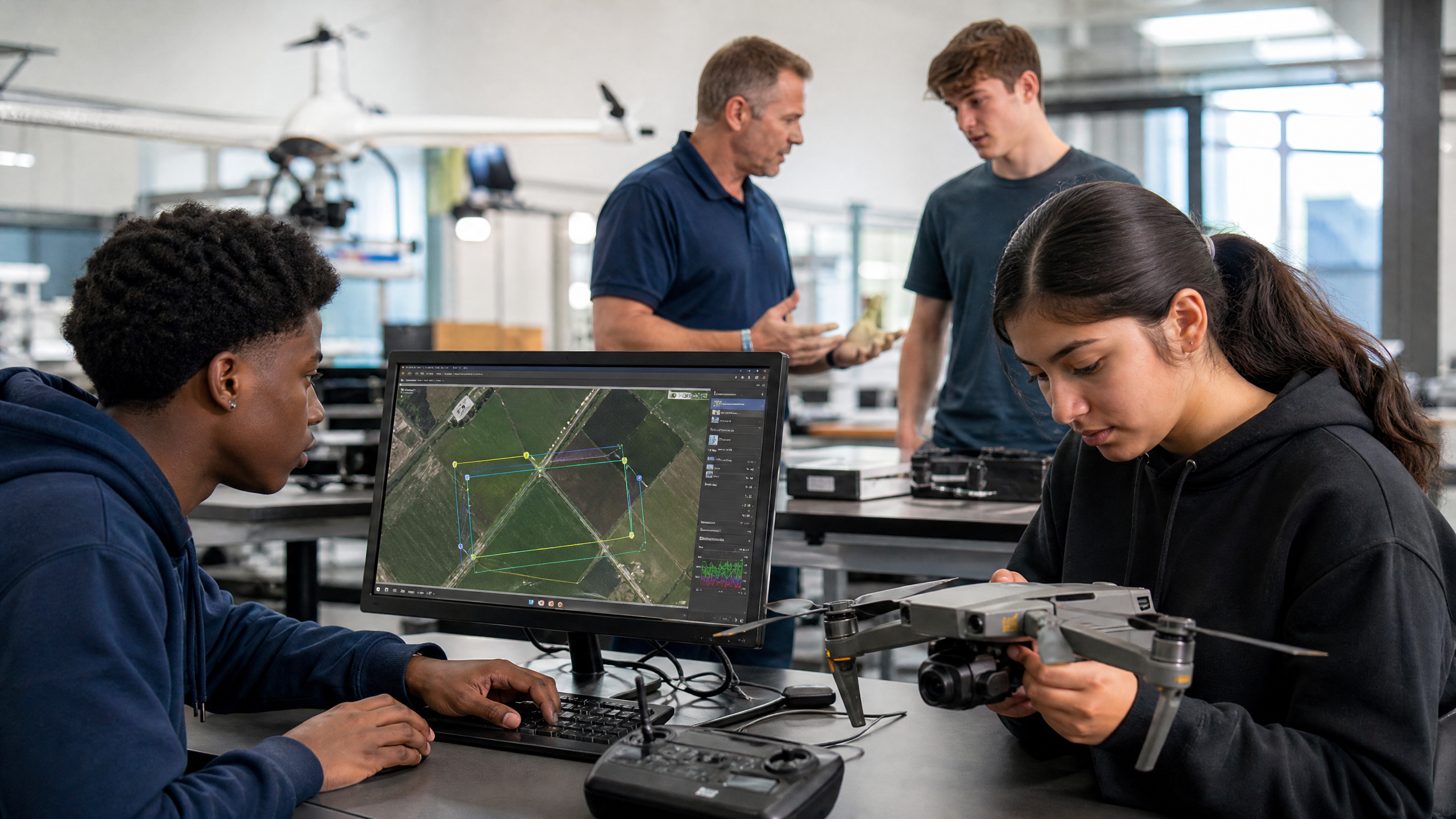
The fastest way to weaken an agreement is to negotiate credit before the two institutions have mapped learning. Start with a working session involving the high-school CTE teacher, the community-college faculty lead, a curriculum administrator from each institution, and—where appropriate—an employer advisory member. Bring course syllabi, lesson and lab inventories, safety documents, grading rubrics, and evidence of student work.
Then build a two-column or three-column crosswalk. On one side, list the high-school outcomes: UAS vocabulary, aeronautical decision-making, preflight procedures, airspace concepts, mission planning, flight logs, visual observer roles, image capture, and project documentation. On the other, list the destination college course outcomes and the specific evidence that demonstrates equivalency. A third column should identify gaps, including required lab hours, software access, instructor qualifications, or assessments that need to be added.
Use the FAA framework carefully. The FAA states that a first-time applicant for a Remote Pilot Certificate must be at least 16, pass the Unmanned Aircraft General—Small knowledge test, and meet other eligibility requirements. Certificate holders must also complete recurrent online training every 24 calendar months to maintain aeronautical knowledge recency. That means a high-school course can build FAA-aligned knowledge and establish a valuable pre-certification pathway, but it should never promise a certificate to a student who does not yet meet the FAA’s requirements. Confirm the current FAA Remote Pilot Certificate requirements.
“A pathway is strongest when it removes duplicate learning—not when it simply adds a college logo to a high-school course.”
— Pathway design principle
For a practical starting point, review DLL’s guide to FAA Part 107 test preparation for high-school students with your partner faculty. It can help separate the foundational topics students need before college from the advanced applications—such as mapping, inspection, automation, or data analysis—that make the postsecondary experience meaningfully different.

Put the Agreement in Writing: Six Decisions to Resolve
Once the course map reveals a real match, convert the design into a written agreement. Your legal, academic, and dual-enrollment rules will vary by state and institution, so obtain review from the appropriate district and college offices. The operational agreement, however, should resolve the same six decisions almost everywhere:
- Eligible students: Define the grade level, required coursework, minimum performance, attendance expectations, and any placement or advising steps.
- Credit mechanism: State whether students earn transcripted credit immediately, credit after matriculation, advanced placement into a later course, or credit through an assessment process.
- Course equivalency: Identify the exact high-school course, the exact college course or program element, the shared outcomes, and the evidence used to validate them.
- Faculty and instructional standards: Clarify whether the high-school teacher must be approved by the college, what professional development is required, and how changes in staffing are handled.
- Assessment and records: Specify common assessments, passing thresholds, portfolio expectations, transcript procedures, student-data permissions, and who retains evidence.
- Review and renewal: Establish an annual review date, a process for curriculum updates, a contact list, and the conditions under which the agreement can be revised or ended.
Be precise about the student experience. A family should be able to answer four questions from the agreement or its accompanying pathway guide: What do I take in high school? What evidence do I need to earn recognition? What happens when I enroll at the partner college? Which course or credential comes next? Ambiguity becomes an equity issue when only the most informed families can navigate the path.
See a Turnkey Drone Pathway in Action
Explore how DLL gives educators FAA-aligned curriculum, hands-on learning, and the documentation needed to build a credible pathway conversation with a college partner.
Align Faculty, Equipment, Assessment, and Student Supports
Credit transfer is only the visible part of an articulation agreement. The real work is making sure that students experience comparable quality, no matter where they complete the secondary portion of the pathway. The federal Programs of Study framework specifically calls for partnerships, vertical curriculum alignment, nonduplicative course sequences, credit-transfer agreements, professional development, and accountability systems. Build these features into the launch rather than treating them as later enhancements.
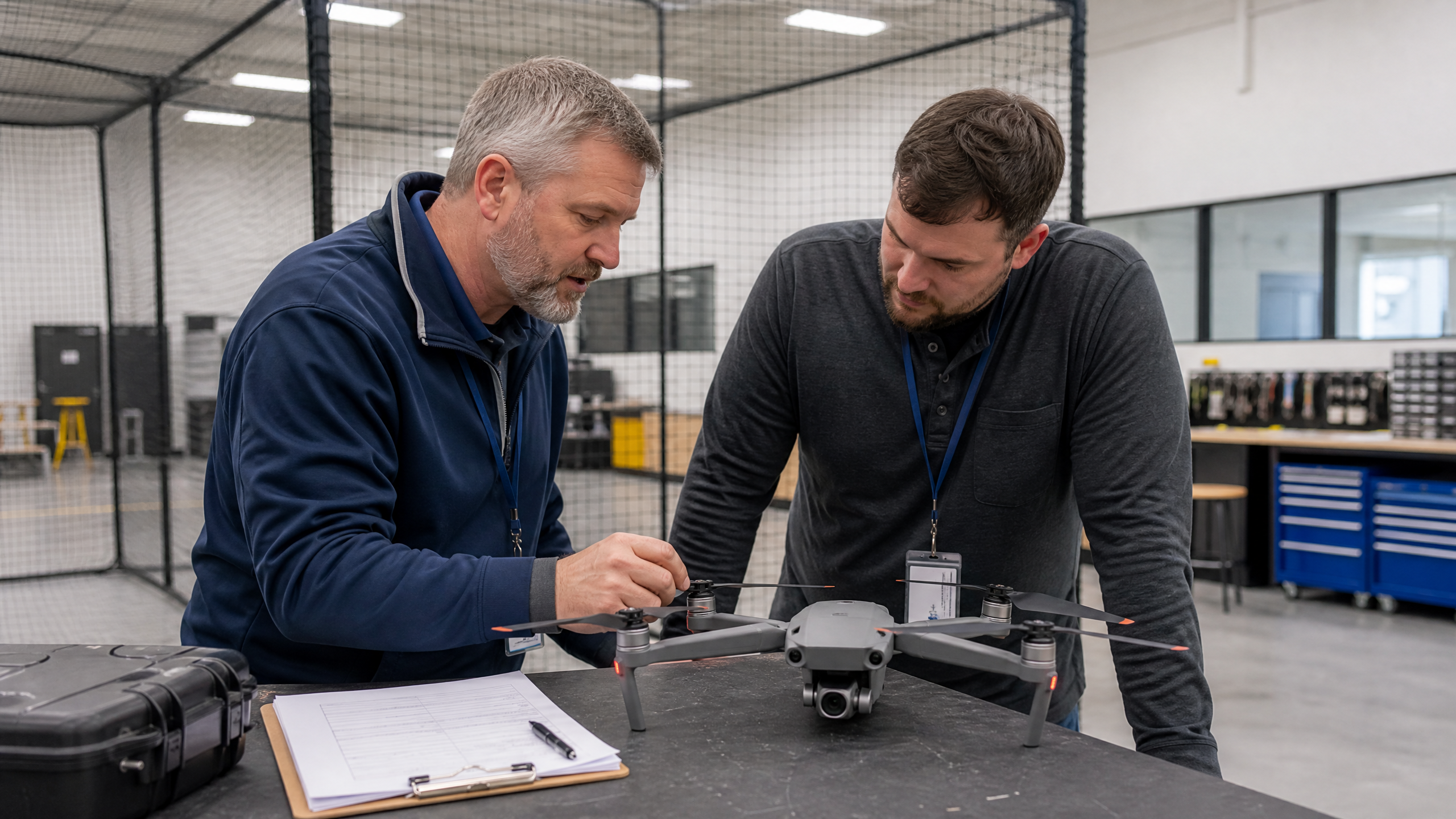
Start with faculty alignment. Schedule at least one annual calibration session in which high-school and college instructors review a student flight-log sample, a mission-planning project, and a written safety assessment. The goal is not to make every course identical. It is to make the college confident that a student who meets the high-school standard has genuinely earned the next step.
Next, address equipment and lab experience. If the college expects students to use mapping software, mission-planning tools, or specific aircraft types in the next course, decide whether the high-school program will introduce those tools or explicitly prepare students for the transition. A high school does not need to replicate every college lab; it does need to describe what it can validate confidently. For ideas on building a career-relevant sequence, see DLL’s high-school drone mapping curriculum guide.
Launch, Measure, and Improve the Pathway
Begin with a pilot cohort rather than trying to scale the agreement to every student in year one. Select a small group of students who are likely to complete the high-school course, have a realistic interest in the partner college, and can provide useful feedback. Build in an orientation for families and counselors so that the terms of the opportunity are understood before the first enrollment decision.
Track results that tell you whether the agreement is functioning as designed. Useful measures include the number of students completing the high-school course, the share who qualify for the agreement, the number who enroll at the partner institution, credits accepted or advanced placement awarded, subsequent college-course success, relevant credentials earned, and persistence into the next term. Review the data jointly with the college each year and make it part of your broader CTE advisory conversation.
Do not announce “college credit” until your college partner, district leadership, and advising teams agree on exactly how and when students earn it. Use accurate language such as “eligible for articulated credit upon enrollment” when that is the actual mechanism. Clear communication protects students and protects the partnership.
Finally, keep the agreement current. Drone technology, FAA rules, college catalogs, faculty qualifications, and local workforce needs all change. An annual review is not administrative overhead; it is what keeps the pathway credible. If you are still securing initial internal approval, use DLL’s guide to earning school approval for a drone program to frame the opportunity around outcomes, safety, and a clear implementation plan.

Key Takeaways
- ✓ Define whether your model is articulation, dual enrollment, or simply a referral relationship before you promise credit.
- ✓ Map shared learning outcomes and assessment evidence before negotiating the credit mechanism.
- ✓ Use FAA Part 107 requirements as a credential-alignment anchor, not as a guarantee for students who are not yet eligible.
- ✓ Document faculty, assessment, advising, equipment, recordkeeping, and annual-review responsibilities in writing.
- ✓ Launch with a pilot cohort, measure the transition outcomes, and improve the agreement with your college partner every year.
Build a Pathway Students Can See and Use
The best drone articulation agreements make the next step obvious. They align real learning, give educators a common standard, help counselors explain the opportunity accurately, and give students a more efficient route from a high-school CTE lab to postsecondary training and credentials. Begin with a shared course map, define the credit mechanism honestly, put the responsibilities in writing, and make continuous review part of the partnership.
Ready to Build a Drone Career Pathway?
Book a demo to see how DLL’s turnkey, FAA-aligned curriculum can help your team create a confident foundation for high school, college, and workforce partnerships.