
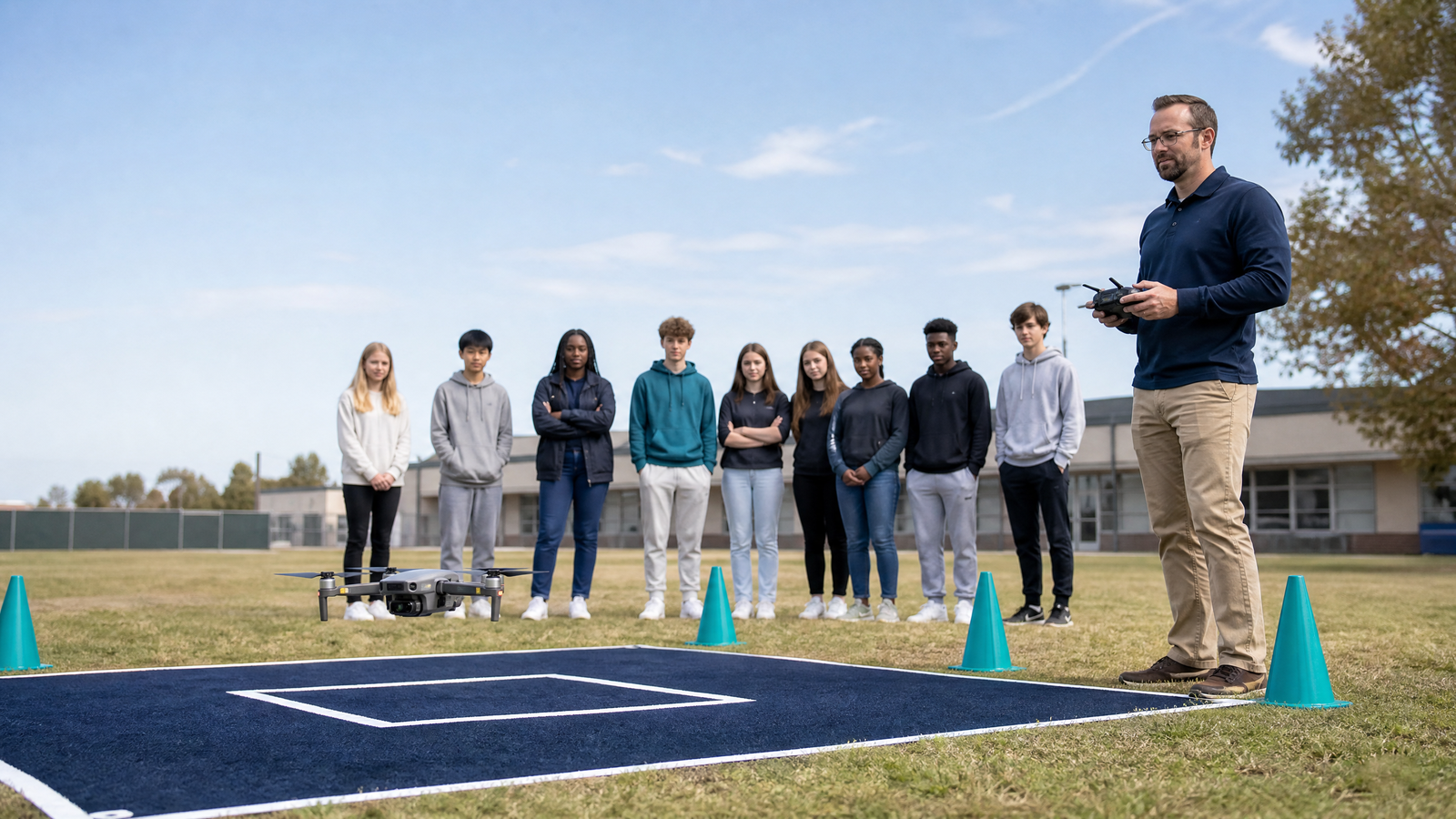
The goal is not to make flight instruction feel bureaucratic. It is to make the routine predictable enough that educators can focus on teaching. A well-designed plan gives students a visible model of professional practice: they learn that pilots do not simply power on an aircraft and improvise. They assess the environment, assign crew roles, inspect equipment, brief the team, and make a deliberate go/no-go decision.
Key Takeaways
- A written plan defines who may authorize and supervise flight operations.
- The correct FAA operating framework should be determined before a program launches.
- Preflight, site, and student-readiness checks make every lesson repeatable.
- Remote ID, registration, and airspace checks belong in the operating workflow.
- Schools should document incidents and use lessons learned to strengthen the plan.
What Is a School Drone Safety Plan?
A school drone safety plan is a written framework for conducting educational drone activities consistently. It is broader than a syllabus and more useful than a one-time permission slip. The plan connects program governance, FAA operating considerations, campus procedures, instructional controls, equipment readiness, and incident response in one document or operating packet.
At a practical level, the plan should answer five questions. Who owns the program and can stop a flight? Under which operating framework will the school fly? What must happen before, during, and after each instructional flight? Where can flights occur, and how will the site be set up? What happens when there is a near miss, an equipment issue, an injury, or an unexpected change in weather or airspace conditions?
The safest school drone program is not the one with the most rules—it is the one where every adult and student can reliably follow the same flight routine.
That repeatability matters in an educational setting. Different class periods, substitute teachers, field locations, or student crews should not change the basic standard of care. The best plans are concise enough to use on a busy instructional day, yet specific enough that administrators, families, and partners can see how the school manages risk.
Start With the Correct FAA Operating Framework
The first decision is not which drone to buy. It is how the school’s intended flights fit within the applicable FAA framework. The FAA explains that drones flown for educational purposes are regulated either under the exception for limited recreational operations or under the Small UAS Rule, commonly called Part 107.1 Education by itself does not remove the need to determine which framework applies.
For example, the FAA notes that qualifying educational organizations may operate under the limited recreational exception for qualifying educational and research purposes. Qualifying organizations include institutions of higher education, JROTC programs, and educational programs chartered by an FAA-recognized community-based organization. Other educational organizations that do not meet those conditions must operate under Part 107.1 Because a school’s structure and planned activities matter, a CTE director should document the determination, verify it against current FAA guidance, and align it with district policy and counsel rather than relying on a verbal assumption.
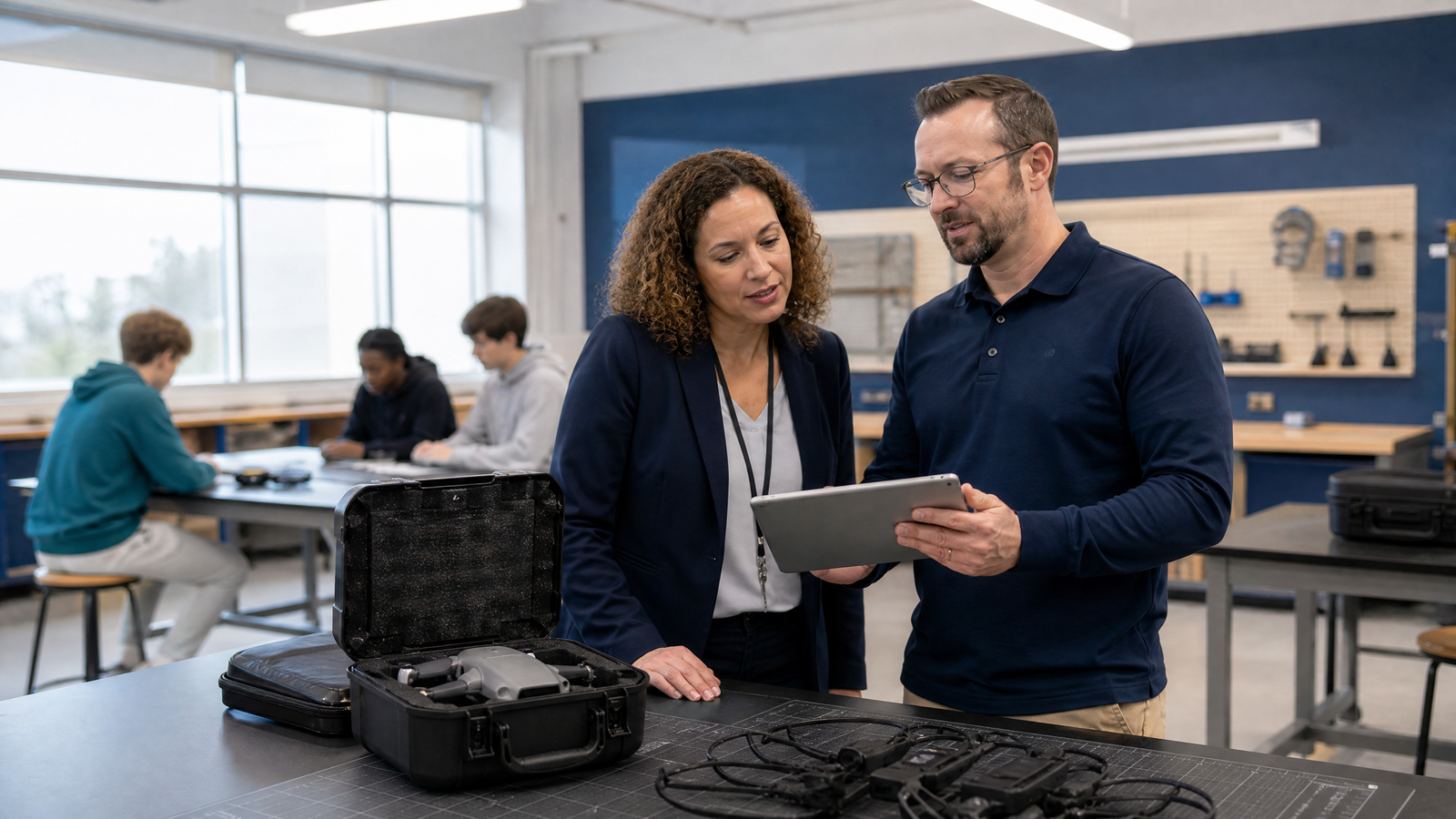
Part 107 is the primary FAA rule for small UAS weighing less than 55 pounds and permits operations for many purposes, including education.1 When a Part 107 operation is planned, the school should identify the certificated remote pilot who has operational responsibility and confirm that the individual’s required recurrent training is current. The FAA says remote pilot certificate holders must complete online recurrent training every 24 calendar months to maintain aeronautical knowledge recency.3
Do not treat this section as legal advice or a substitute for an FAA determination. Treat it as a program-management prompt: establish the facts, write down the framework, and build lesson routines that match it.
Assign Roles Before the First Flight
Every flight day needs a clear chain of command. In a small program, one adult may hold several responsibilities; in a larger program, duties may be distributed. Either way, the written plan should name the roles and the authority associated with each one. The program owner maintains the plan, equipment records, and administrative approvals. The flight supervisor or remote pilot, when applicable, makes the operational go/no-go decision. The classroom teacher manages instructional flow. Students act in defined crew roles, such as operator, visual observer, safety lead, or data recorder, only within the limits set by the supervising adult.
Most important, designate one adult with unmistakable stop-flight authority. That person must be able to pause or cancel the activity when there is a crowding issue, an equipment concern, an unexpected visitor, a weather change, a student-readiness concern, or any uncertainty about safe operations. Establishing this authority is not a sign of mistrust; it is an instructional model of sound aeronautical decision-making.
For schools using Part 107, the FAA lists a minimum age of 16 for a remote pilot certificate, along with the initial aeronautical knowledge test and other eligibility requirements.3 Students who are not certificated can still learn valuable crew-resource and safety skills, but the program must preserve the adult’s authority and align each activity with the operating framework.
Build a Repeatable Lesson-Day Operating Routine
Use a purposeful preflight check
Preflight should be a routine, not a last-minute scramble. Before students enter the flight area, the supervising adult and assigned crew should inspect the aircraft, propellers, battery condition, controller, charging setup, and any required identification or Remote ID equipment. They should also review the planned maneuver, the available landing area, the local weather, and any relevant airspace or temporary restriction information. The precise checklist should fit the school’s aircraft and operating framework, but the habit should remain constant: inspect first, brief second, launch last.
Set up the site so boundaries are visible
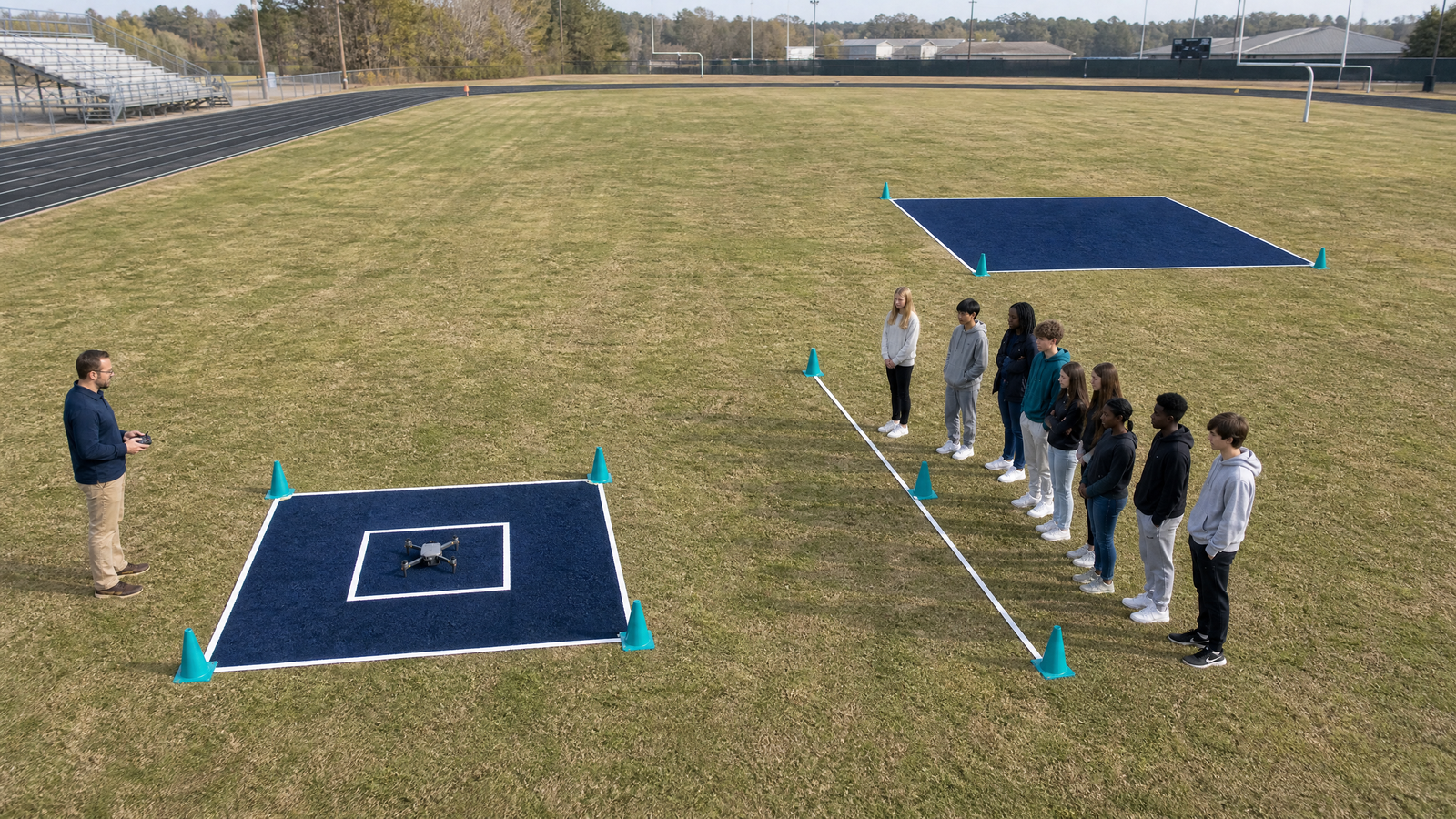
A safe flight area is easy to understand from a distance. Mark the takeoff and landing zone, an observer position, a student staging area, and an emergency landing area. Use cones, field markers, or other simple visual controls that make the boundaries obvious. Brief students on where they may stand, who may approach the aircraft, how a handoff is handled, and what to do if a flight is paused. Choose sites that support visual line of sight, appropriate separation from uninvolved people, and a controlled path for the planned exercise.
Bring a repeatable drone routine to your CTE program
See how structured drone curriculum can help your teachers plan instruction, reinforce safety habits, and connect learning to career pathways.
Teach the briefing as a career skill
Students benefit when the preflight briefing is short, spoken, and repeated. A practical briefing identifies the learning objective, designated operator, visual observer, operating boundaries, planned maneuver, abort signal, and landing area. It also sets the expectation that anyone who sees a condition affecting safety should call it out promptly. That discipline develops communication, situational awareness, and accountability—skills that matter in aviation, inspection, public safety, construction, and many other technical fields.
After the flight, add a quick debrief. What went as planned? What changed? Did the crew follow the communication process? Were any maintenance or site issues discovered? This discussion turns safety from a static document into an observable competency that can be reinforced across the course.
Plan for Remote ID, Registration, Airspace, and Changing Conditions
Remote ID should appear in the plan as a verification process, not as a vague technology note. The FAA states that drones required to be registered, or that are registered, must comply with the Remote ID rule.2 The FAA identifies three main compliance paths: operating a Standard Remote ID drone, using a Remote ID broadcast module, or flying in an FAA-Recognized Identification Area (FRIA).2 Primary and secondary educational institutions are eligible to request FRIAs, which can be an important planning consideration for eligible schools.1
Registration also belongs in the operating record. The FAA distinguishes between recreational registration practices and Part 107 requirements: Part 107 pilots register each individual device, including a Standard Remote ID drone or Remote ID broadcast module, in their inventory.2 Keep a current inventory showing the device, serial information, assigned registration information where applicable, battery or maintenance status, and storage location.
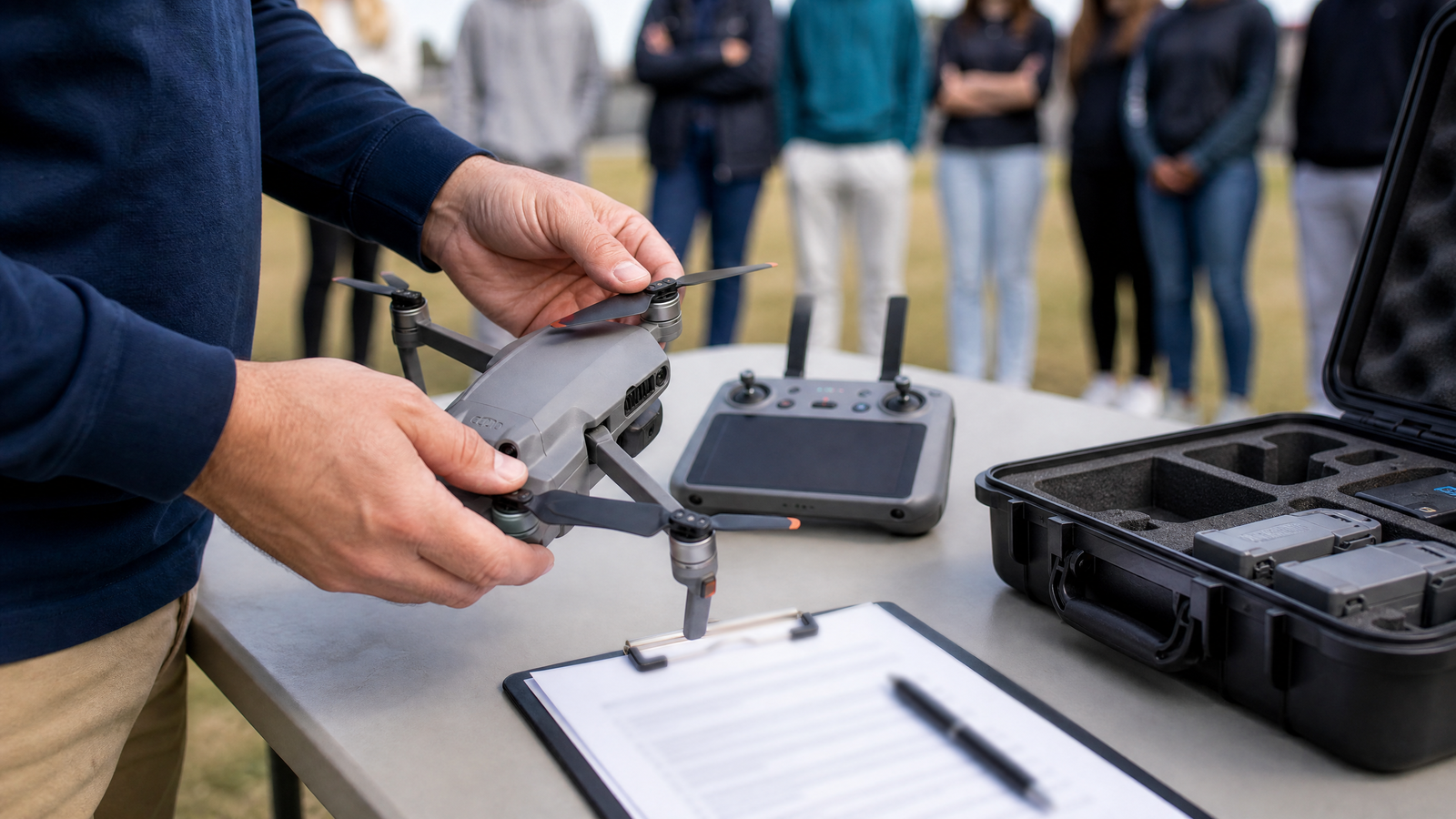
Conditions change even when the lesson plan does not. A campus event can introduce uninvolved people into the area; local weather can change rapidly; a temporary flight restriction or airspace limitation may alter what is appropriate that day. Build a simple go/no-go step into the routine and give the flight supervisor permission to substitute a simulator, maintenance lesson, airspace exercise, or post-flight data-analysis activity when the flight cannot proceed. A canceled flight is not a failed lesson when students understand the reason for the decision.
Prepare for Incidents and Near Misses
No safety plan is complete without a calm response process. The plan should state how to stop the operation, secure the aircraft and batteries, provide first aid or request emergency support when needed, notify the appropriate school contacts, and preserve a factual record of what occurred. Define who contacts families or administrators, but do not leave educators to invent a communication path in the moment.
Near misses deserve attention as well. A battery that swells, an unexpected student entry into the operating area, loss of control-link reliability, or a breakdown in crew communication may not cause harm, but each event can reveal an improvement opportunity. Use a short incident form that captures the date, location, people involved, equipment, conditions, facts, immediate action, and recommended corrective action. Then determine the return-to-flying criteria before the next lesson. Align the response process with the district’s safety, insurance, and reporting requirements.
Put the Plan Into a One-Page Operating Packet
A comprehensive policy can be stored centrally, but the flight-day tool should be brief. Assemble a one-page operating packet or a concise digital equivalent that teachers can use quickly. Version-control it, date it, and review it at least each semester or whenever the aircraft, site, operating framework, district policy, or key personnel changes.
| Packet component | Purpose on flight day |
|---|---|
| Approval and role chart | Confirms who owns the program, supervises flight, and can stop operations. |
| Operating-framework record | Documents the FAA approach and relevant program assumptions. |
| Site diagram | Shows takeoff, landing, observer, student, and emergency areas. |
| Preflight and student briefing | Makes equipment checks and crew expectations repeatable. |
| Equipment and maintenance log | Tracks aircraft condition, batteries, and corrective actions. |
| Incident and near-miss form | Captures facts and supports continuous improvement. |
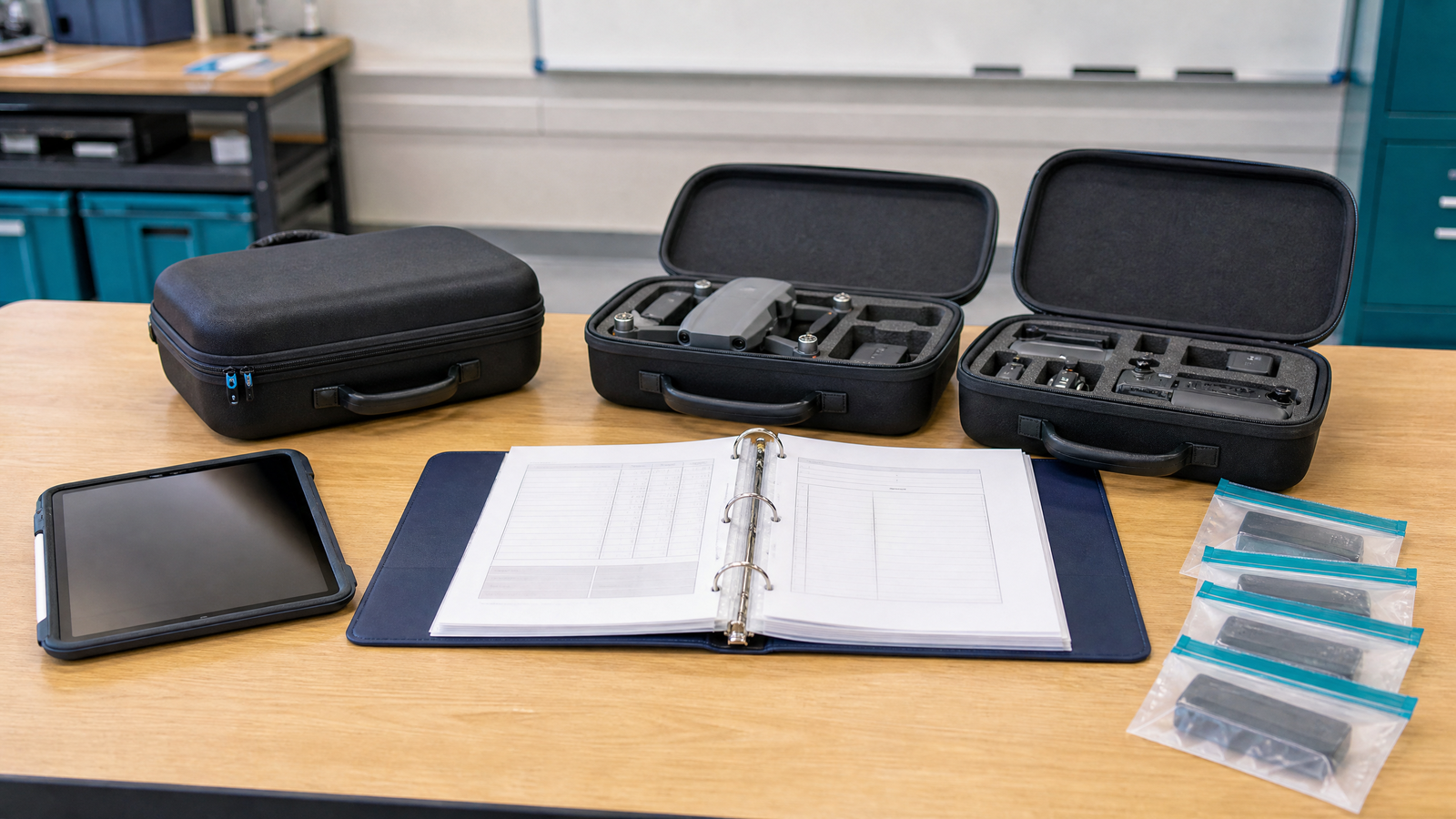
Finally, practice the plan before the first student flight. Walk the site, test the communication method, rehearse the abort signal, and run a simple no-launch scenario. That preparation gives teachers confidence and makes the safety plan a living part of instruction rather than a binder on a shelf.
Make Safe Operations the Program’s Operating System
A school drone safety plan helps educators deliver hands-on learning with structure, transparency, and professional discipline. When roles are clear, the FAA operating framework is documented, flight-day routines are consistent, and near misses become improvement opportunities, students can see what responsible UAS operations look like in practice. That is a meaningful foundation for career-connected CTE learning.
Ready to build a safer, career-connected drone program?
See how Drone Launch Learning helps educators deliver structured drone instruction, safety routines, and career-ready learning.