A middle school drone curriculum works when it treats drones as a tool for teaching aviation, data, and career awareness, not as a miniature pilot-training course. Students in grades 6–8 are usually too young to hold an FAA Remote Pilot Certificate, which requires applicants to be at least 16, so the teacher flies and students learn every other part of the mission: planning, safety, observation, data, and communication. That constraint shapes the course for the better. It rewards teamwork and reasoning instead of stick time.
This guide covers what to teach across three grade levels, how to keep flights legal with younger students, what equipment to buy first, and how the course feeds a high school CTE pathway.
What should a middle school drone curriculum include?
Build the course around four strands, and assess all four. A program that only measures flying leaves the most transferable skills ungraded.
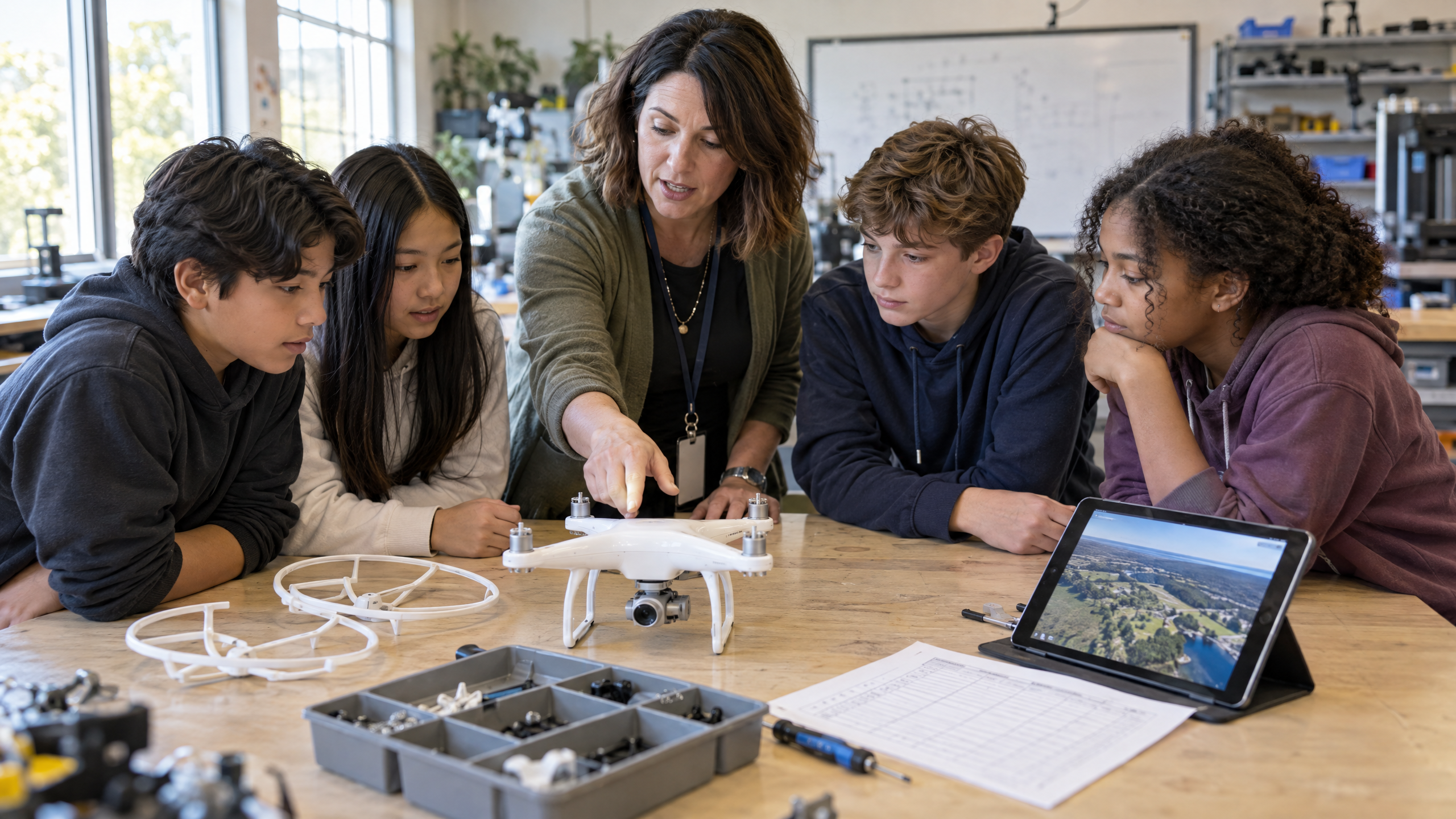
Aviation and airspace fundamentals cover parts and systems, the forces of flight in plain language, airspace classes, weather, registration, Remote ID, and the difference between recreational and commercial rules. Students should be able to explain why a flight is legal before anyone powers on a controller.
Supervised flight skills cover preflight inspection, takeoff, hover, landing, yaw, and simple patterns such as squares and circles. Start in a simulator so first flights are not also first mistakes. Data and media covers aerial photography, basic mapping, measurement, and how to turn an image into a useful product. Career awareness connects each mission to occupations in inspection, agriculture, surveying, public safety, and media.
The workforce context is why the course belongs in CTE rather than as an elective curiosity. The FAA forecasts the commercial drone fleet to exceed one million aircraft in 2025 and reach about 1.12 million by 2029. Demand also reaches occupations that use aerial data rather than fly for a living.
Sources: FAA Aerospace Forecast FY 2025–2045; Bureau of Labor Statistics, cartographers and photogrammetrists; BLS, surveying and mapping technicians. Fleet figures are the FAA base scenario. Wage and opening figures describe entire occupations, not entry-level drone pilot pay, and are not guarantees of local hiring.
Why does drone learning work in the middle grades?
Federal policy now expects career exploration to start before high school. Perkins V requires states to provide career exploration and career development activities through an organized framework, including in the middle grades, which the law defines as grades 5 through 8. Districts may use Perkins funds for CTE coursework at that level, so a drone unit can be funded as a real course rather than a club.
The evidence for starting early is encouraging but should be read carefully. A 2026 Kentucky study matched 37,622 students who took CTE in eighth grade against similar peers who did not. Students with middle school CTE enrolled in high school CTE at 80.3% versus 77.0%, and reached CTE concentrator status at 58.3% versus 54.6%. Those are modest differences with small effect sizes in one state, not proof that drones alone change outcomes. They do suggest that early exposure keeps students on a pathway.
Source: Kentucky Department of Education, Middle School Career Exploration Impact on High School CTE Outcomes (2026). Results describe CTE participation broadly, not drone courses specifically, and measure association rather than causation.
The goal of a middle school drone course is not a license. It is a student who can explain why a mission is safe, what the data shows, and where the work leads.
How is a middle school program different from a high school program?
The biggest difference is legal, not pedagogical. A student cannot become the pilot in command under Part 107 until age 16, because that is the FAA’s minimum age to apply for a Remote Pilot Certificate. A seventh grader can learn every regulation in the course and still not legally fly the mission solo.
Schools therefore plan around an adult pilot. The FAA explains that educational drone flights operate under either Part 107 or the limited recreational exception in 49 U.S.C. §44809. The exception applies to qualifying organizations such as institutions of higher education, JROTC programs, and programs chartered by an FAA-recognized community-based organization. A district that does not qualify must operate under Part 107 with a certificated remote pilot, which is typically the teacher.
Recreational rules still matter for students who fly on their own. Flyers operating under §44809 must pass the free Recreational UAS Safety Test (TRUST) and carry proof, and drones heavier than 0.55 pounds must be registered. Teaching TRUST early gives students a legitimate, low-stakes first credential.
What does a three-year sequence look like?
A workable sequence gives each grade a different job. DLL’s curriculum is built for 9–18 week implementations at roughly three to five instructional hours per week, and the same pacing works below ninth grade.
Grade 6: foundations without flight
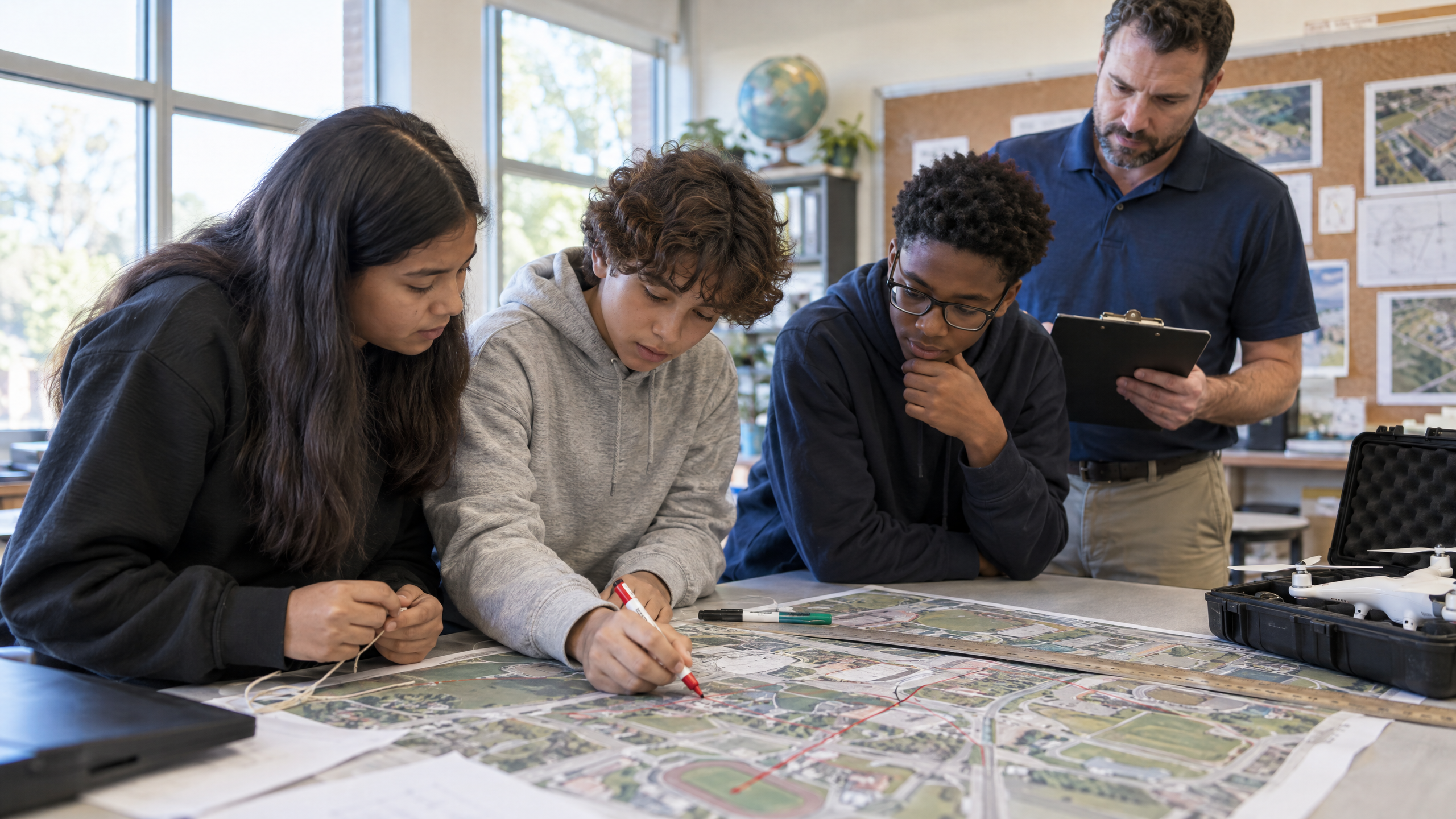
Sixth graders learn parts, safety, airspace, weather, and the vocabulary of missions. Most work happens in simulators, on paper maps, and with image interpretation. The capstone is a tabletop mission plan: a problem, a flight path, a hazard list, and a briefing.
Grade 7: supervised flight and sensors
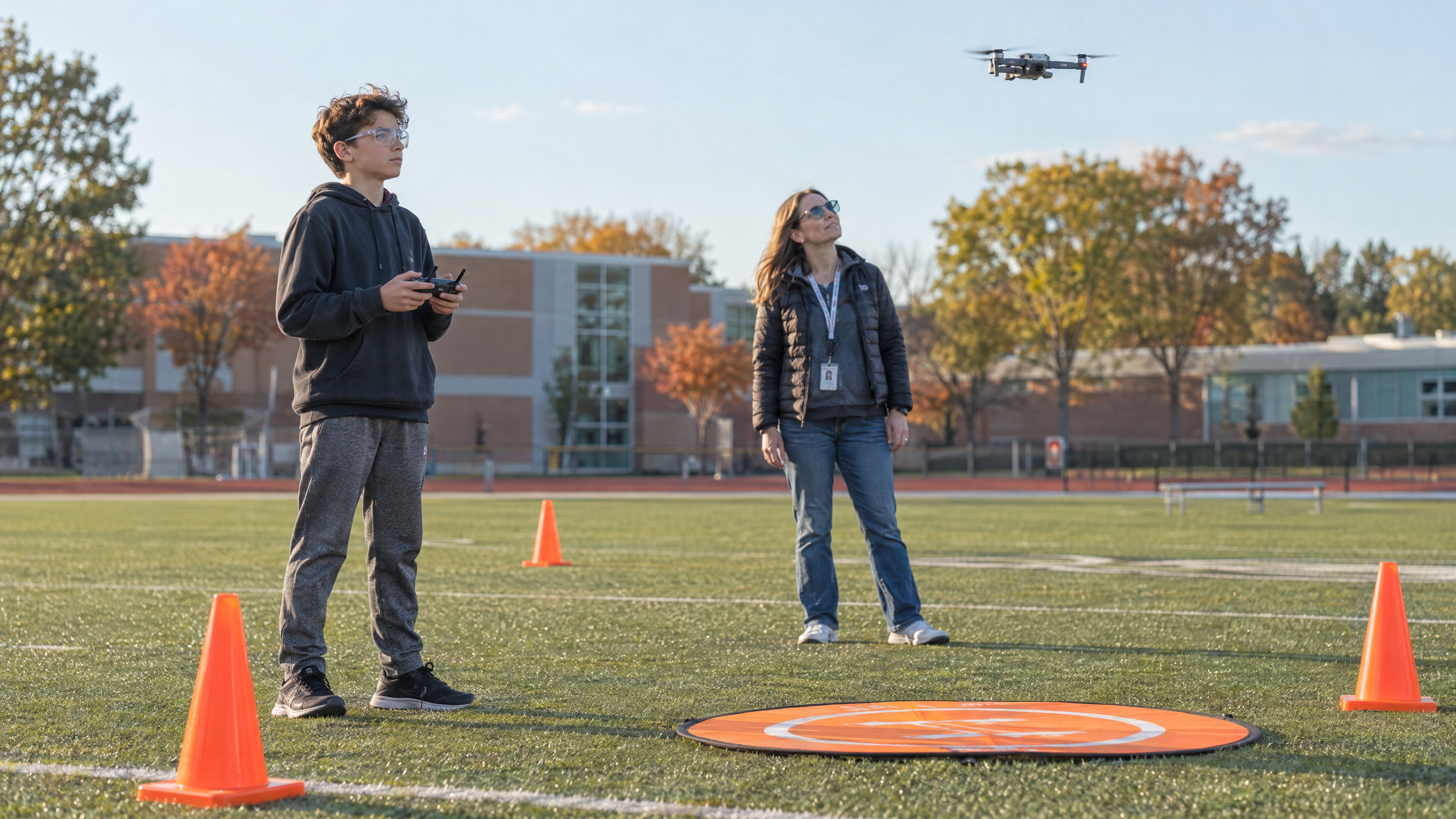
Seventh graders move outdoors with the teacher as pilot in command. They run preflight inspections, practice maneuvers, learn camera settings, and take a first pass at mapping a small area. Crew roles rotate so every student experiences observation and safety, not just the controller.
Grade 8: missions, data, and careers
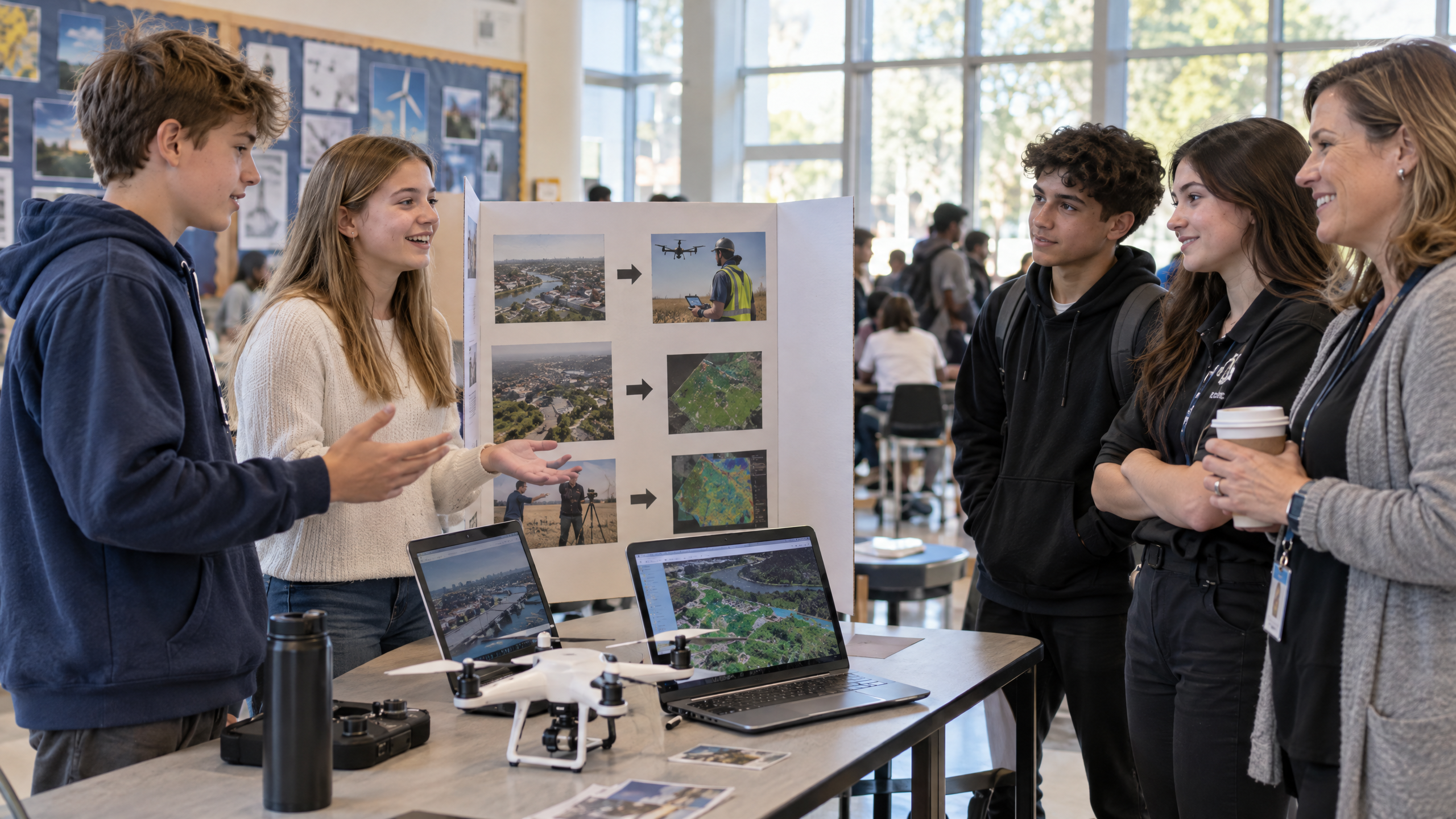
Eighth graders take a mission for a real internal client, such as documenting a courtyard drainage issue or photographing the athletics complex for the yearbook. They deliver a data product, a short brief, and a career portfolio that travels with them to high school.
How do you align a middle school drone unit with standards?
Drones fit existing standards better than most electives. The NGSS engineering design standards for middle school (MS-ETS1) ask students to define a problem, specify constraints, and optimize a design, which is exactly what mission planning requires.
In CTE, the unit supports the Science, Technology, Engineering and Mathematics cluster, the Transportation, Distribution and Logistics cluster, and portions of Agriculture and Public Safety. Math connections include scale, coordinate systems, area, and unit conversion. English language arts connections include procedural writing, technical briefs, and oral presentation. Document the alignment in your course outline; principals and Perkins reviewers ask for it.
How do you run safe flights with 11- to 14-year-olds?
Safety comes from roles, not reminders. Assign a pilot in command (the teacher), a visual observer, a flight director who owns the checklist, a safety officer who can call a stop, and a data recorder. Rotate every flight so students internalize each responsibility.
Survey the site before the first flight: airspace, people, vehicles, wires, wind, and a clear landing area. K–12 schools can request an FAA-Recognized Identification Area (FRIA), which allows flights without Remote ID broadcast. Keep the aircraft within visual line of sight, below 400 feet, and away from bystanders.
Manage batteries like the hazard they are. Charge under supervision, store in a fire-resistant bag, inspect for swelling, and retire damaged packs. Keep a written preflight checklist and an incident log, and follow your district’s school drone safety plan.
See how a middle school feeder fits your CTE pathway
Book A Demo to walk through the lessons, activities, and Part 107 prep that carry students from grade 6 to certification.
What equipment and space do you need?
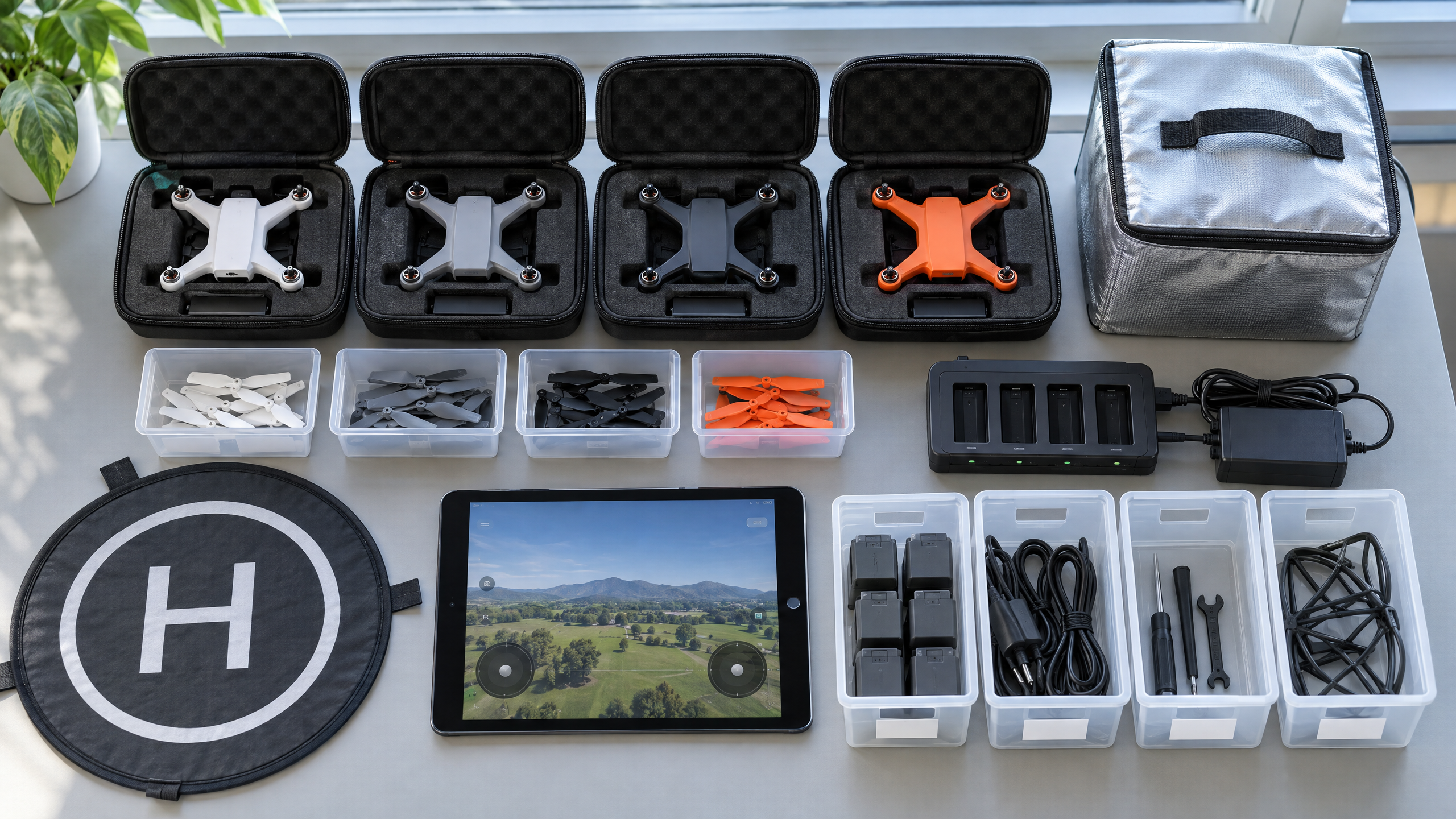
Start with durable entry-level quadcopters that survive beginner mistakes, and plan a student-to-drone ratio near 3:1 so students rotate rather than wait. Buy spare propellers, extra batteries, a multi-port charger, a landing pad, cones, and labeled storage bins. Add a fire-resistant battery bag and a tablet for simulators before you add a second aircraft model.
For space, a gymnasium supports low hovering and precision landing. A courtyard or field supports missions once the site plan is approved. Wind, rain, and heat decide more flight days than the calendar does, so keep simulator lessons ready as a fallback.
How do you connect middle school to a high school CTE pathway?
Treat grades 6–12 as one program of study rather than two programs that happen to share equipment. Align vocabulary, share a safety manual, and let high school students mentor eighth graders during capstone presentations. Those moves make the transition visible to families.
Formal connections matter too. Use articulation agreements and dual credit where your district allows them, and ask your advisory committee which entry-level skills employers actually screen for. The Perkins V program of study guide walks through the course sequence and approval language, and the high school launch guide covers what students should already know when they arrive.
How should you assess middle school drone learning?
Grade four domains on a simple proficiency scale: safety and preflight discipline, flight control, mission planning and data quality, and communication and reflection. Require every student to explain one decision, acknowledge one limitation, and name a next step.
Keep evidence in a portfolio: checklists, flight logs, the data product, a short written brief, and a reflection. That portfolio does more for pathway placement than a flight score, because it shows a teacher what the student can do without a controller in hand.
Frequently asked questions
Can middle school students earn a Part 107 certificate?
Not yet. Applicants must be at least 16 to earn a Remote Pilot Certificate, so most middle schoolers study the content but cannot be certificated. They can pass TRUST, fly recreationally within the rules, and operate as crew under a certificated teacher.
Can we teach drones without buying aircraft?
Yes. Simulators, paper mission planning, image interpretation, and career research cover most of the first semester. Add aircraft after the site plan, safety manual, and supervision model are approved.
How much time does a middle school drone unit need?
A full course runs 9–18 weeks at three to five hours per week. A shorter enrichment unit of six to eight weeks works if it leans on simulators and limits outdoor flight to a few capstone days.
Does a middle school drone course count as CTE?
It depends on your state and district. Perkins V allows CTE in the middle grades, and many states offer career exploration course codes. Confirm the course code, teacher certification, and reporting requirements with your CTE director before you recruit students.
Build a middle school feeder that feeds a real CTE pathway.
Book A Demo to see how the Drone Launch Learning curriculum can anchor grades 6–12 and prepare students for Part 107 at the right age.