
Integrating Drones into High School Physics and Math: A Hands-On Approach
For decades, high school physics and mathematics have struggled with a common student complaint: “When will I ever actually use this?” While textbooks provide foundational knowledge, they often fail to capture the imagination of students who crave real-world applications. Integrating drones into high school physics and math changes that narrative completely. By bringing unmanned aerial vehicles (UAVs) into the classroom, educators can transform abstract equations into tangible, high-flying experiments.
Drones are not just tools for career and technical education (CTE) or media production; they are flying physics laboratories and airborne geometry engines. When students program a drone’s flight path or calculate its battery efficiency under load, they are actively applying core STEM concepts. This guide explores how STEM educators can seamlessly integrate drone technology into their existing curriculum to dramatically boost engagement, deepen conceptual understanding, and prepare students for the future workforce.
The Physics of Flight: Real-World Aerodynamics
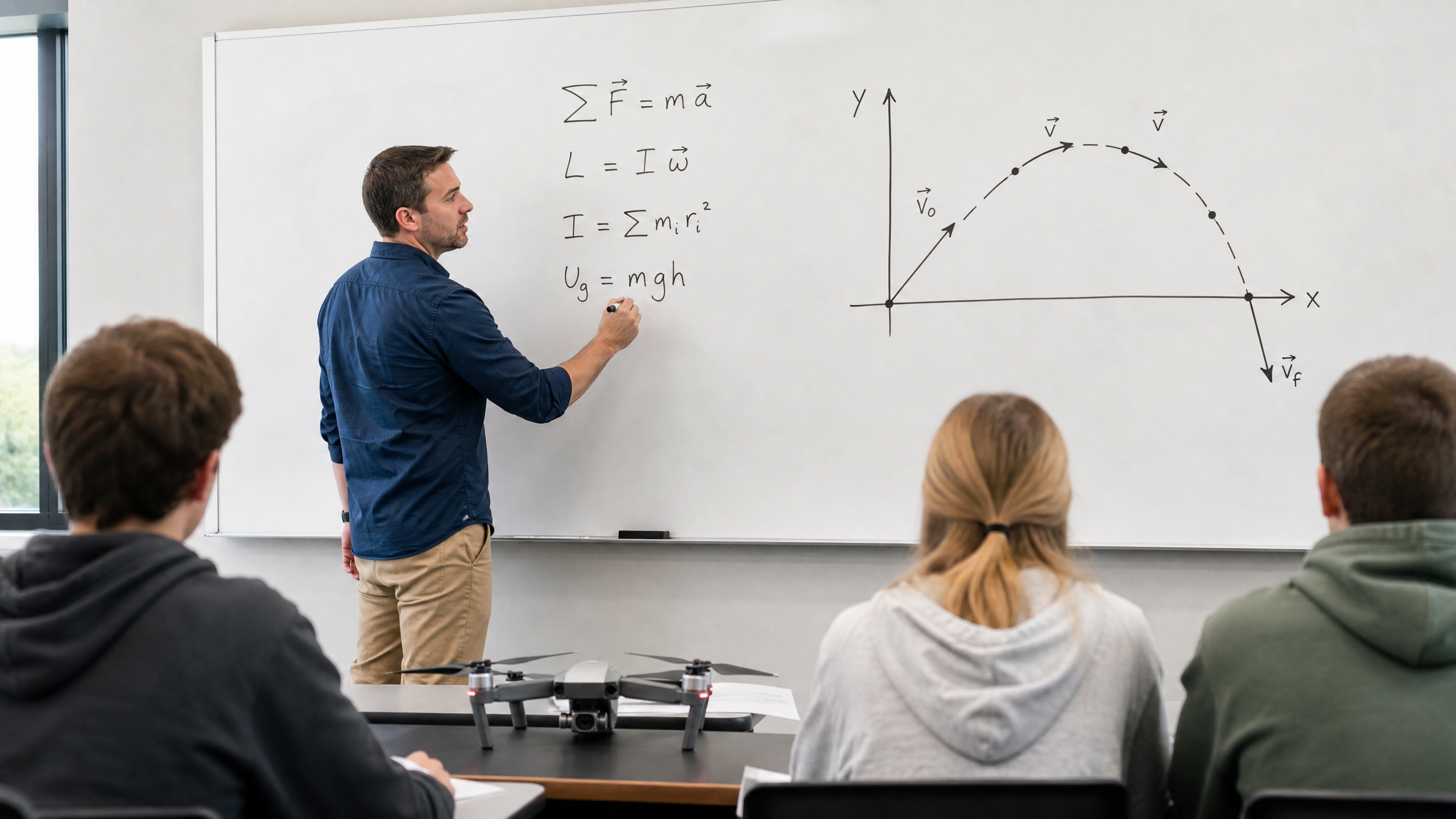
One of the most immediate ways of integrating drones into high school physics is through the study of aerodynamics and forces. Traditional physics lessons on lift, thrust, weight, and drag often rely on static diagrams or simplified wind tunnel simulations. A quadcopter, however, provides a dynamic, observable model of these forces in action. When a drone hovers perfectly still, students can visually confirm that the upward force of lift exactly equals the downward force of gravity.
Educators can design experiments where students calculate the thrust required to lift varying payloads. By attaching small weights to a drone and measuring the power output needed to maintain a hover, students engage in direct application of Newton’s Second Law of Motion (F=ma). Furthermore, studying the rotational mechanics of the drone’s propellers offers a practical entry point into torque, angular momentum, and gyroscopic precession.
Beyond basic forces, drones offer a unique way to study kinematics. By recording a drone’s flight with a high-speed camera or utilizing onboard telemetry data, students can plot position, velocity, and acceleration over time. Analyzing this data requires students to apply calculus and algebra to real-world, messy data sets, bridging the gap between theoretical math and practical physics.
m/s²Acceleration Due to Gravity
Geometry and Trigonometry in the Sky
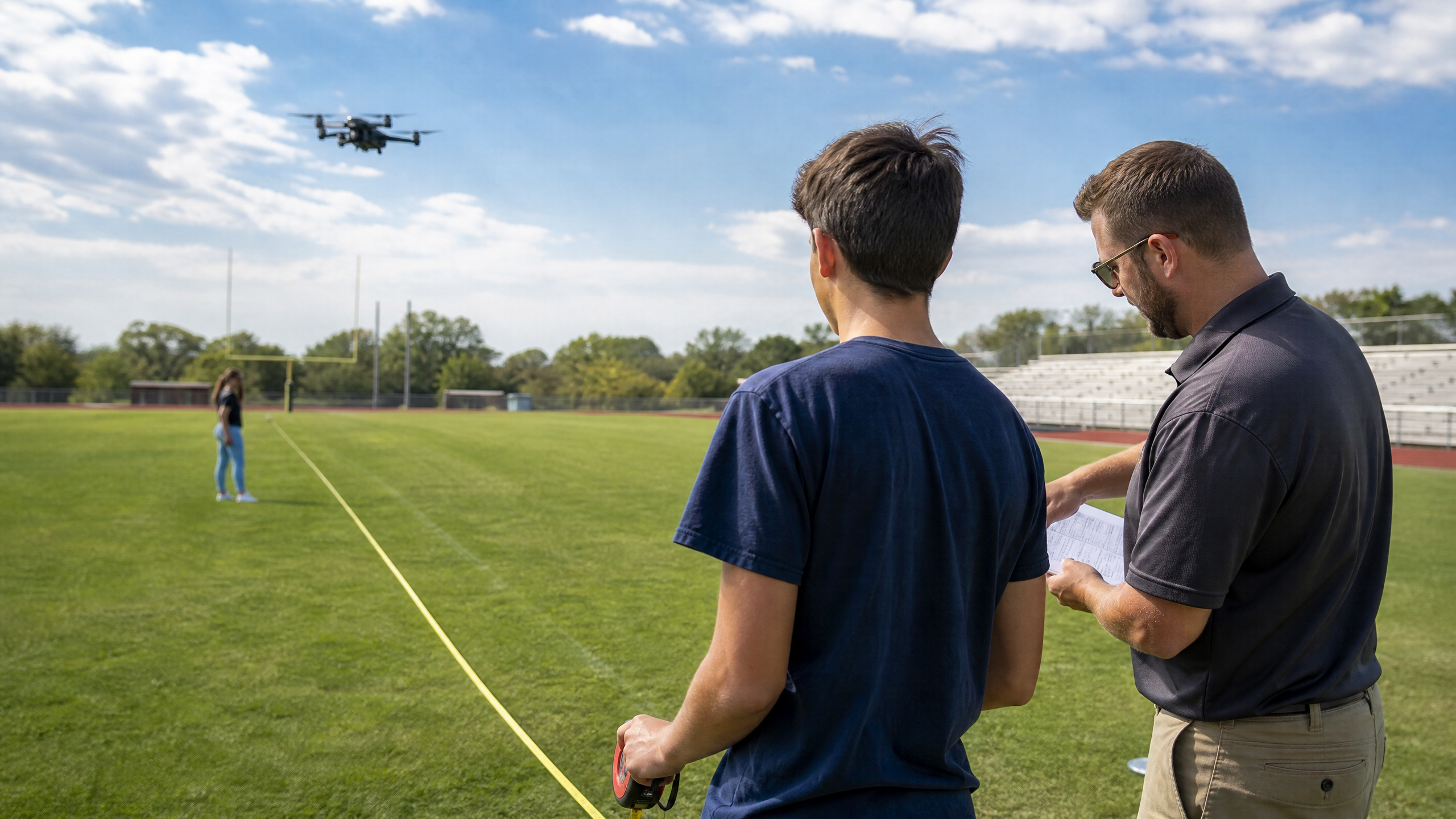
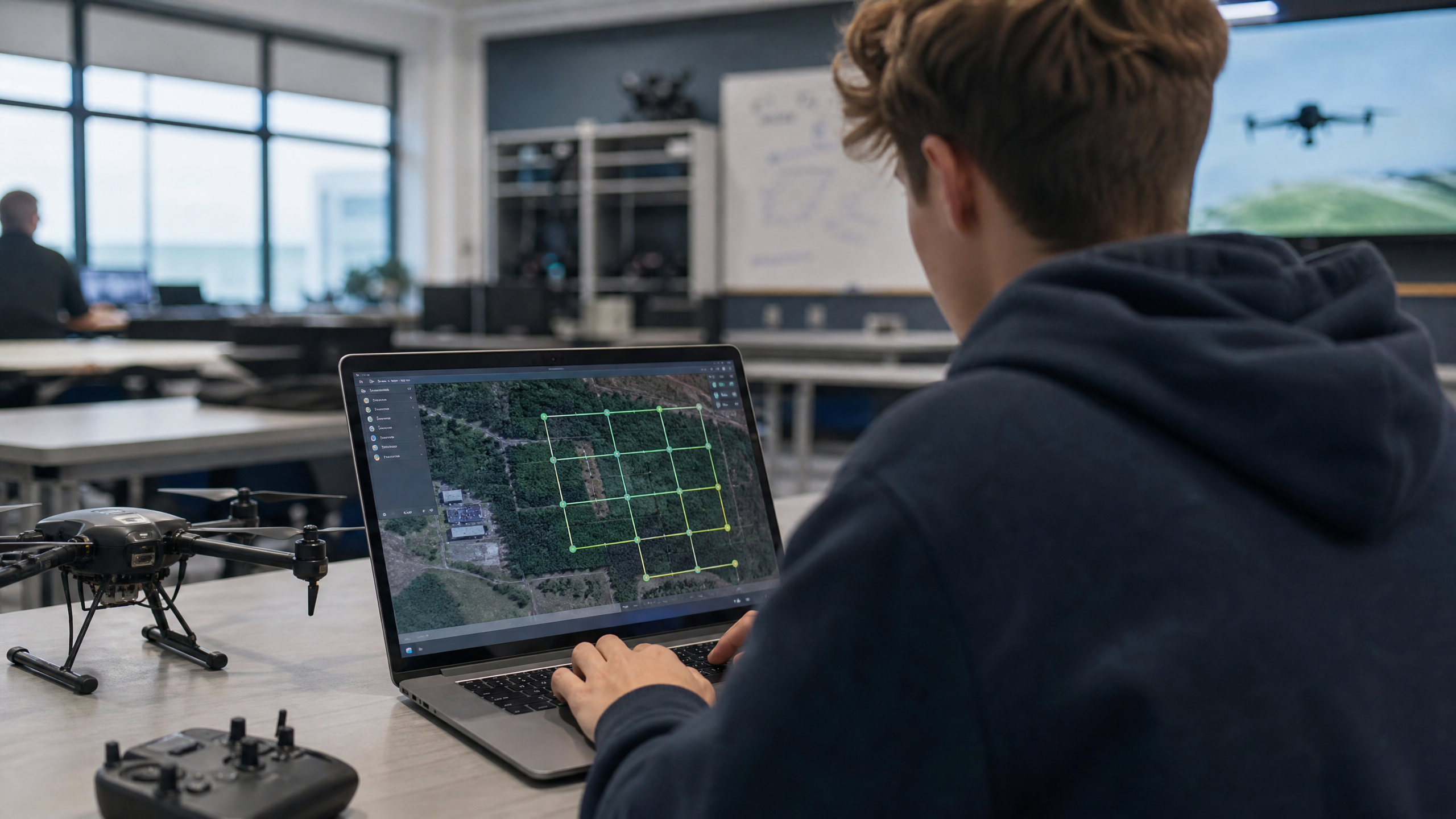
Integrating drones into high school math classes breathes life into geometry and trigonometry. A core function of commercial drones is mapping and surveying, which relies entirely on spatial mathematics. When students plan a flight mission to map their school’s football field, they must calculate the area of the polygon, determine the optimal flight lines, and ensure proper image overlap — all of which require geometric reasoning.
Trigonometry becomes essential when students calculate the altitude of a drone or the height of an object the drone is observing. By using the drone’s camera gimbal angle and its horizontal distance from a target, students can use the tangent function to determine height. This exercise replaces the classic “flagpole shadow” textbook problem with an interactive, technology-driven challenge.
Advanced math classes can delve into 3D coordinate geometry. Drone flight controllers operate using X, Y, and Z axes (pitch, roll, and yaw). Having students map a 3D flight path on paper and then program the drone to execute that exact path requires a deep understanding of spatial coordinates and vectors. When the math is correct, the drone flies flawlessly; when it is wrong, the immediate feedback drives iterative problem-solving.
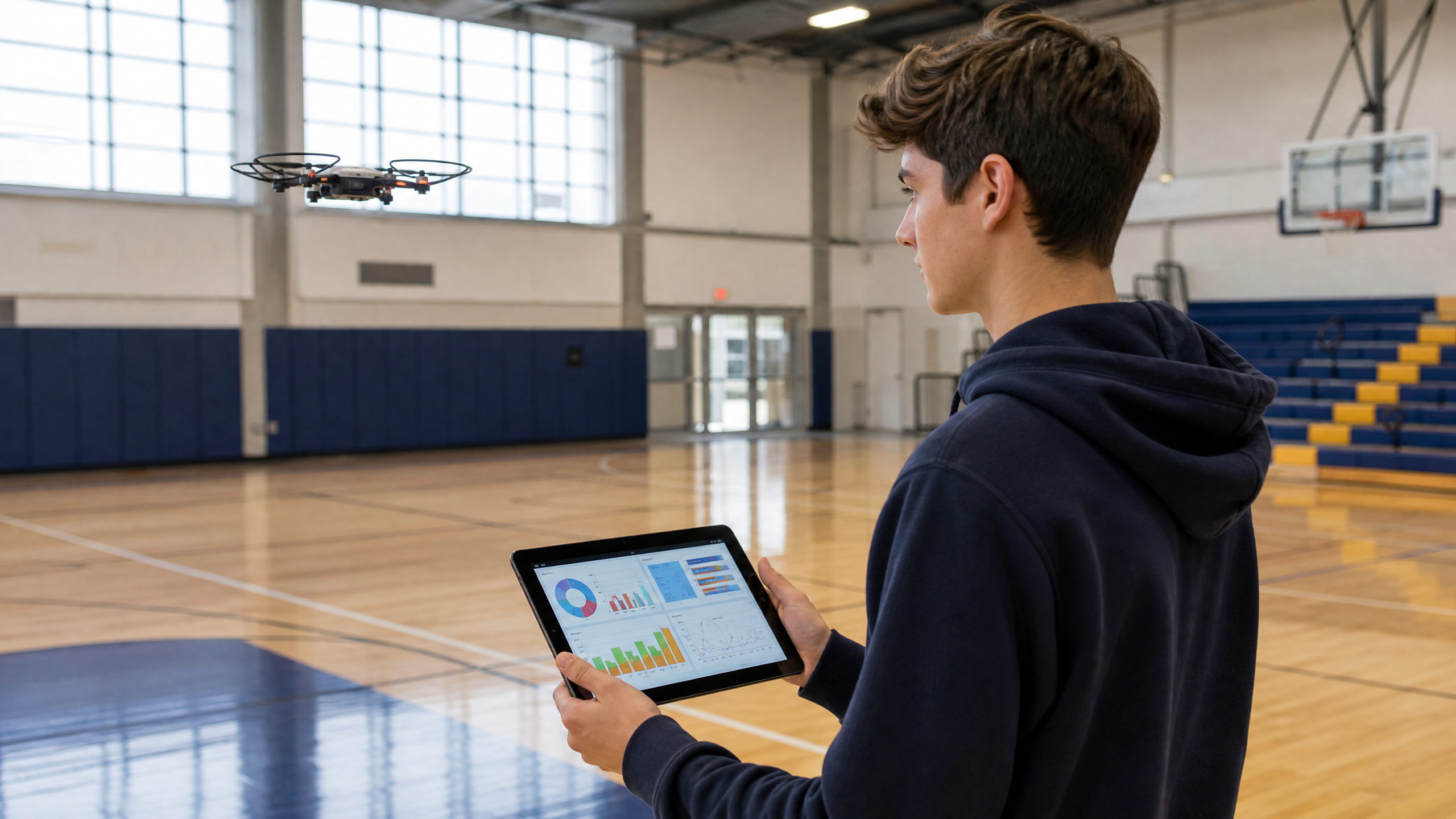
Start small. Before flying, have students calculate the theoretical flight time based on battery capacity (mAh) and average current draw. Then fly the drone and compare the theoretical math to the empirical result — the discrepancy itself becomes a lesson in real-world variables.
Data Collection and Statistical Analysis
Modern drones are essentially flying sensor platforms. They collect vast amounts of data, including GPS coordinates, barometric altitude, battery voltage, and motor RPM. This wealth of information makes drones incredible tools for teaching statistics and data analysis. Instead of analyzing arbitrary datasets from a textbook, students can analyze telemetry data they generated themselves.
For example, a class could conduct multiple flights under different wind conditions to measure battery drain. Students would then compile the data, calculate means and standard deviations, and determine the correlation coefficient between wind speed and power consumption. This process teaches students how to handle outliers, understand variance, and draw evidence-based conclusions from raw data.
Furthermore, this type of data analysis directly mirrors the work done by professional drone pilots in industries like precision agriculture and infrastructure inspection. By learning to parse and interpret flight logs, students are developing highly marketable skills. Integrating drones into high school physics and math in this way ensures that the curriculum remains relevant to the demands of the modern economy.
When students realize that the trigonometry they are learning is the exact same math used to program autonomous drone flights, their engagement skyrockets.
Overcoming Implementation Challenges
While the benefits are clear, integrating drones into high school physics and math does present logistical challenges. Safety is the primary concern. Schools must establish clear indoor and outdoor flight protocols. Indoor flights require propeller guards and safety netting, while outdoor flights must comply with FAA Section 44809 regulations for educational use. It is crucial to consult with your administration and ensure all activities are fully insured and approved.
Another challenge is the learning curve for educators. Many math and physics teachers do not have prior aviation experience. This is where a structured, turnkey curriculum becomes essential. Rather than piecing together YouTube tutorials, schools should invest in professional development and curriculum packages that provide ready-made, standards-aligned lesson plans.
Finally, budget constraints can be a hurdle. However, drones used for educational purposes do not need to be $2,000 commercial rigs. Programmable micro-drones designed specifically for STEM education are highly affordable and perfectly suited for indoor physics and math experiments. Additionally, many STEM grants and Perkins V funding can be utilized to purchase this equipment.
Want a Turnkey Drone Curriculum for Your STEM Classes?
Drone Launch Learning provides ready-made, standards-aligned lessons that any teacher can use — no prior drone experience required.
Connecting Classroom Math to Drone Careers
The ultimate goal of integrating drones into high school physics and math is to prepare students for the future. The commercial drone industry is projected to reach $54.6 billion by 2030, creating a massive demand for skilled operators who understand the science behind the technology. These careers go far beyond simply steering a joystick; they require deep analytical skills.
In precision agriculture, pilots use multispectral cameras to calculate the Normalized Difference Vegetation Index (NDVI), a mathematical formula that determines crop health. In construction, drone operators use photogrammetry software to calculate the volumetric mass of dirt stockpiles. These are direct applications of high school math and physics.
By exposing students to these concepts early, educators are building a pipeline to high-paying, high-demand careers. Students who master the mathematics of drone flight are better prepared for college engineering programs, FAA Part 107 certification, and immediate entry into the technical workforce.
Show your students how drone mapping software uses photogrammetry to turn 2D images into 3D models. It is a perfect real-world example of advanced geometry in action — and a direct pathway to a six-figure surveying career.
Key Takeaways
- Drones provide dynamic, real-world models for teaching physics concepts like lift, thrust, and kinematics.
- Flight planning and mapping require direct application of geometry and trigonometry.
- Drone telemetry offers rich, empirical datasets for teaching statistical analysis.
- Safety protocols and a structured curriculum are essential for successful implementation.
- Applying math and physics to drone technology prepares students for high-demand, high-wage careers.
Conclusion
Integrating drones into high school physics and math transforms abstract concepts into engaging, hands-on learning experiences. By using drones as flying laboratories, educators can teach aerodynamics, spatial geometry, and data analysis in a way that resonates with students. This approach not only improves academic outcomes but also directly connects classroom learning to the rapidly growing commercial drone industry.
Bringing this technology into your school does not have to be overwhelming. With the right curriculum, safety protocols, and professional development, any STEM teacher can successfully implement drone-based lessons. Empower your students to see the math and physics in the world around them, and watch their engagement take flight.
Ready to Integrate Drones into Your STEM Classes?
Book a demo with Drone Launch Learning today to discover our turnkey curriculum and educator training program.