
High School Drone Curriculum: A Practical Guide for CTE and STEM Educators
High school drone curriculum is quickly becoming one of the most practical ways for schools to connect STEM instruction, aviation literacy, career and technical education, and workforce readiness in a single hands-on program. For CTE directors, principals, and classroom teachers, drones offer something rare: a technology that students can see, operate, troubleshoot, program, measure, and connect to real careers in the same semester.
The challenge is that a successful drone program cannot be built around flying alone. A strong curriculum must teach safety, airspace, weather, flight operations, aircraft systems, mission planning, data collection, and career applications. It should also help students understand why professional drone operations are regulated, how FAA Part 107 fits into the workforce pathway, and how drone skills transfer into industries such as agriculture, construction, energy, public safety, mapping, media, and environmental science.
This guide is written for educators who need a practical structure. It explains what belongs in a high school drone course, how to align the program with CTE outcomes, and how to create a responsible pathway from classroom learning to career exploration.
What Should a High School Drone Curriculum Accomplish?
A drone curriculum should do more than introduce students to a popular technology. It should help them understand unmanned aircraft systems as a professional field. The FAA explains that drone pilots flying small drones for work or business generally operate under Part 107 guidelines, and the agency outlines three major steps for commercial operators: learn the rules, become an FAA-certified remote pilot by passing the Unmanned Aircraft General knowledge test, and register the drone when required.[1]
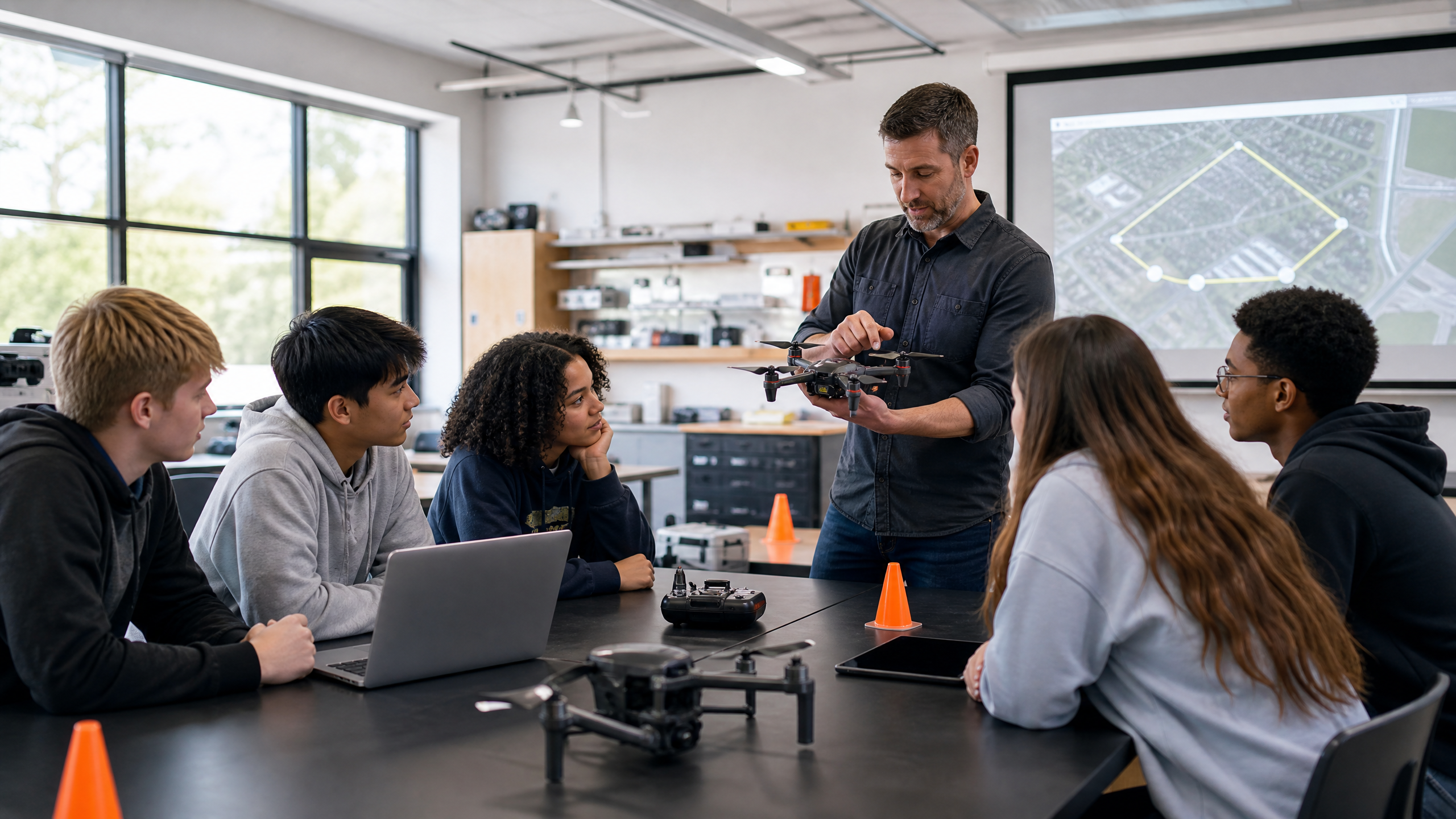
That framework gives schools a helpful north star. Students do not need to become commercial pilots on day one, but they should learn that drone operations are built on rules, documentation, judgment, and safety culture. A classroom program should therefore blend technical knowledge with repeated decision-making practice. Students should be able to explain where drones can fly, how weather affects operations, what a preflight inspection includes, and how to choose the right tool for a mission.
For educators, the most effective outcome is not simply student enthusiasm. The goal is measurable readiness. By the end of an introductory course, students should be able to follow classroom safety procedures, explain the difference between recreational and non-recreational operations, identify airspace and weather considerations, complete a basic mission plan, and describe several drone-related career pathways.
The Six Pillars of an Effective Drone Course
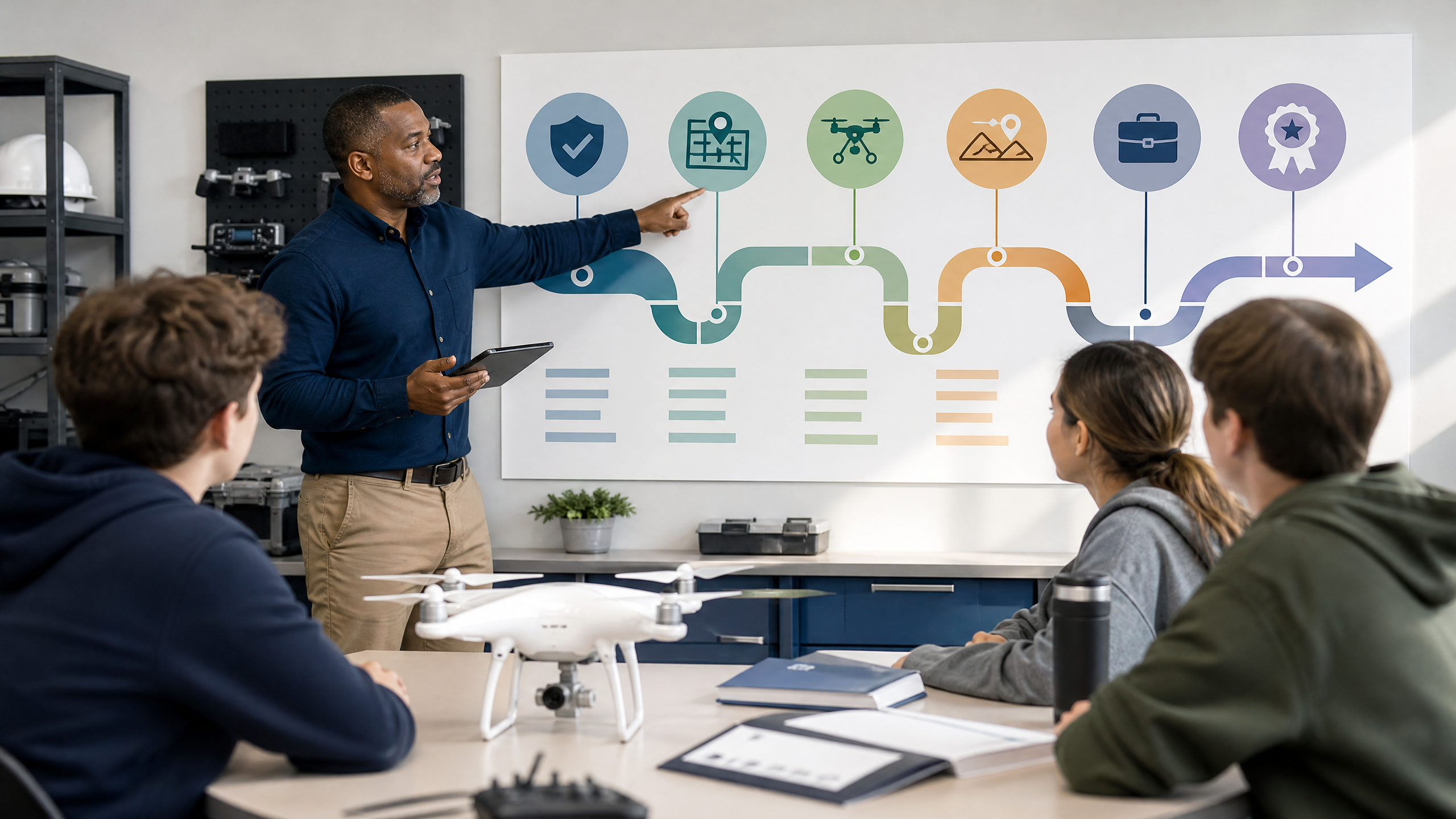
A balanced drone program should include six instructional pillars. First, students need safety and professionalism. This includes classroom rules, battery handling, propeller safety, risk assessment, privacy awareness, and responsible decision-making. Second, they need airspace and regulations, including the basic concepts behind controlled airspace, remote pilot responsibilities, and why compliance matters.
Third, students need flight skills. Even short indoor training flights can teach coordination, situational awareness, communication, and crew roles. Fourth, they need aircraft systems knowledge. A drone is not just a flying camera; it is a system made of frames, motors, propellers, batteries, sensors, controllers, software, payloads, and maintenance practices. Fifth, they need mission planning and data, because many professional drone uses involve collecting images, measurements, maps, inspections, or observations. Sixth, they need career connection, so the technology becomes part of a pathway rather than a one-off classroom activity.
Curriculum Design Tip
Build the course around professional habits first, then flight skills. Schools that lead with safety, documentation, and mission planning create stronger programs than schools that treat drones as a novelty activity.
This structure is consistent with how many education-focused drone programs organize content. For example, one published drone curriculum model emphasizes theory and design, flight skills, programming, and preparation for the FAA Remote Pilot Certification Exam.[2] That combination matters because schools serve students with different strengths. Some students may love flight operations, while others may be more interested in coding, electronics, mapping, agriculture, or public safety applications.
How to Fit Drone Curriculum Into a CTE Pathway
Drone courses fit especially well within CTE because they naturally combine technical skills, industry rules, employability skills, and applied projects. A state-level CTE course framework from Virginia describes an Unmanned Aircraft Systems course for grades 10, 11, and 12 that runs for 36 weeks, provides 140 hours of instruction, and prepares students to understand the national airspace system, FAA regulations, drone design and operation, weather, loading and performance, logistics, administrative tasks, training, and piloting.[3]
That example is useful because it shows administrators that drone education can be more than an enrichment unit. It can be organized as a full-credit course, embedded into existing STEM and CTE pathways, or introduced as a semester course that grows over time. The right model depends on staffing, facilities, student demand, and local workforce partnerships.
| Program Model | Best Fit | Primary Goal |
|---|---|---|
| Introductory STEM unit | Middle school or early high school exploration | Build awareness through safety, coding, and simple flight tasks |
| Semester elective | High school STEM or technology education | Teach core drone operations, mission planning, and applications |
| Full CTE course | Grades 10–12 pathway development | Prepare students for advanced coursework, credentials, and work-based learning |
| Capstone or advanced lab | Students with prior robotics, aviation, agriculture, or engineering coursework | Apply drones to mapping, inspection, public safety scenarios, or local industry problems |
For most schools, the best starting point is a semester course or a structured unit inside an existing CTE program. This lowers the barrier to launch while still giving teachers enough time to teach safe operations, vocabulary, mission planning, and career relevance.
Part 107 Readiness Without Turning the Class Into Test Prep
FAA Part 107 readiness is important, but a high school drone curriculum should not become only a test-prep course. The FAA states that eligible remote pilot applicants must be at least 16 years old, able to read, write, speak, and understand English, and be in a physical and mental condition to safely fly a UAS.[1] Those requirements make Part 107 especially relevant for high school juniors and seniors, but younger students can still begin learning the concepts that lead to responsible operations.
A strong drone course does not ask students to memorize aviation rules in isolation; it helps them practice the judgment, communication, and planning habits that make those rules meaningful.
The most practical approach is to layer certification concepts throughout the course. When students learn weather, connect it to go/no-go decisions. When they learn airspace, connect it to mission planning. When they learn maintenance, connect it to preflight risk reduction. When they learn crew roles, connect it to professional communication. This gives students context before they encounter certification language.
Teachers can also use scenario-based assessments. Instead of asking only, “What is the rule?” ask students to review a proposed school event, identify operational risks, determine what information they need, and explain whether the mission should proceed. This reflects real-world thinking and helps administrators see the academic value of the course.
Equipment, Facilities, and Safety Planning
Schools do not need to launch with expensive aircraft or a large outdoor flight area. Many strong programs begin with small indoor drones, prop guards, floor markings, safety cones, battery procedures, and clear classroom roles. What matters most is consistency. Every flight activity should have a preflight checklist, assigned student responsibilities, a defined flight area, and a procedure for stopping operations.
Administrators should plan for four categories: aircraft, learning space, teacher preparation, and operating procedures. Aircraft decisions should be based on learning goals. Indoor microdrones are excellent for first flights and coding practice, while camera drones may be appropriate later for supervised data missions. Learning spaces should include a netted or clearly marked flight zone when possible. Teacher preparation should cover both curriculum delivery and school-specific risk management. Operating procedures should address batteries, storage, maintenance logs, student permissions, privacy, and incident response.
Administrator Checklist
Before buying a full drone fleet, define the course outcomes, identify the teacher training plan, select indoor and outdoor operating procedures, and decide how student learning will be assessed.
Connecting Drones to Real Career Pathways
One reason drones work so well in CTE is that they are not limited to aviation. A single drone lesson can connect physics, geometry, computer science, environmental science, construction, agriculture, emergency response, entrepreneurship, and media production. The Virginia CTE framework connects unmanned aircraft systems with topics such as the national airspace system, FAA regulations, weather, logistics, administrative tasks, and high-quality work-based learning.[3] That breadth helps schools justify drone programs as career preparation rather than a narrow technology elective.
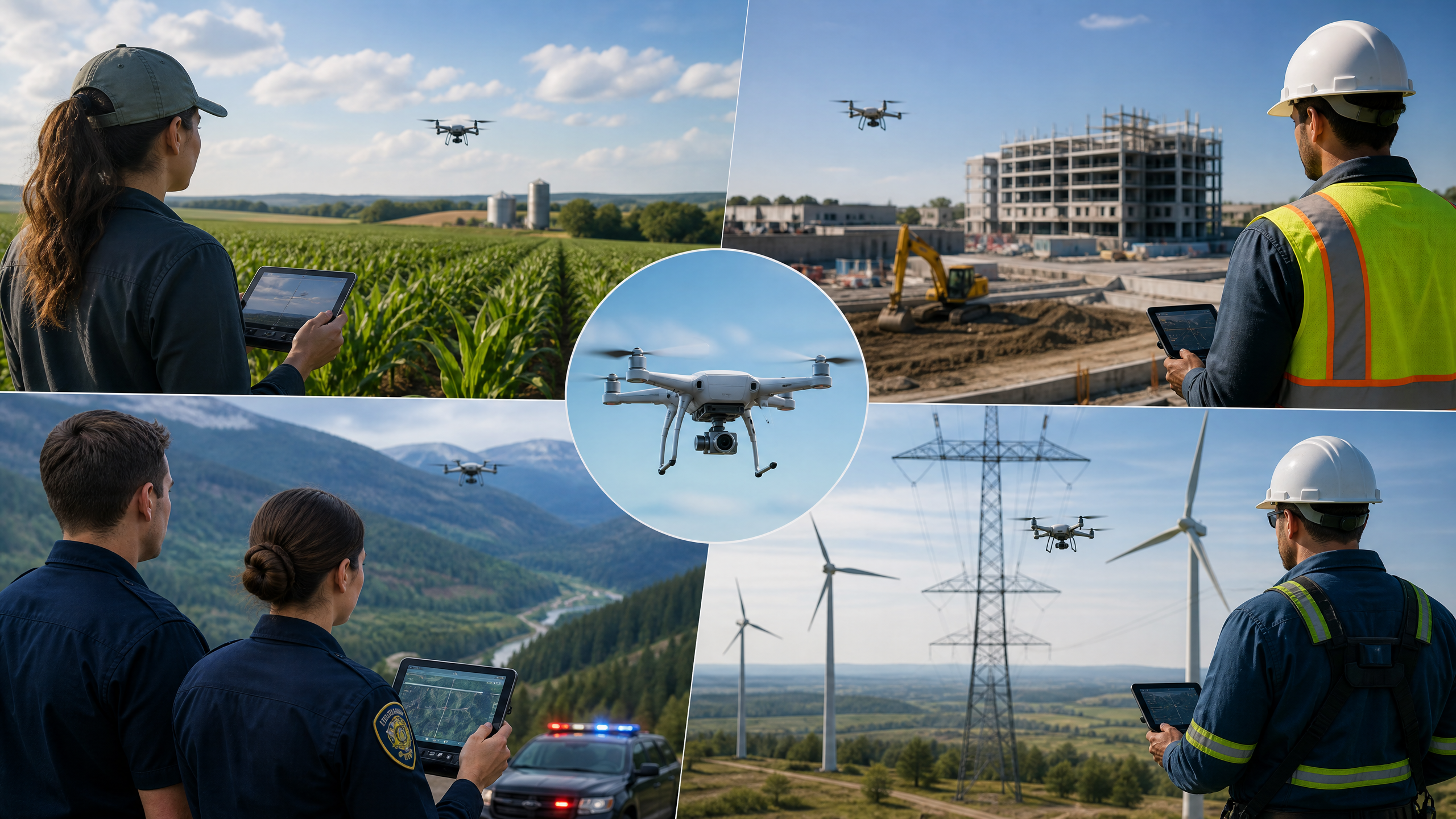
Career exploration should be explicit. Students can compare how a drone mission differs across industries. In agriculture, the task might involve crop scouting or plant health imagery. In construction, it might involve progress documentation or site mapping. In public safety, it might involve search support or situational awareness. In environmental science, it might involve erosion monitoring or habitat observation. In each case, students should identify the mission goal, the data needed, the safety considerations, and the professional roles involved.
| Career Area | Classroom Application | Student Skill Developed |
|---|---|---|
| Agriculture | Plan a crop-monitoring mission from a sample field map | Observation, data interpretation, mission planning |
| Construction | Analyze progress photos and identify documentation needs | Spatial reasoning, communication, project documentation |
| Public Safety | Design a search pattern for a simulated emergency scenario | Team communication, risk assessment, operational planning |
| Environmental Science | Use aerial imagery to discuss erosion, water flow, or habitat change | Scientific observation, evidence-based reasoning |
| Information Technology | Program a small drone or organize collected mission data | Computational thinking, data management, troubleshooting |
How to Assess Student Learning
Assessment should measure both knowledge and performance. A drone curriculum can include vocabulary quizzes and written reflections, but it should also evaluate checklists, teamwork, documentation, and mission planning. Students can maintain a flight operations notebook, complete preflight inspections, write safety briefs, analyze weather data, and present a career application project.
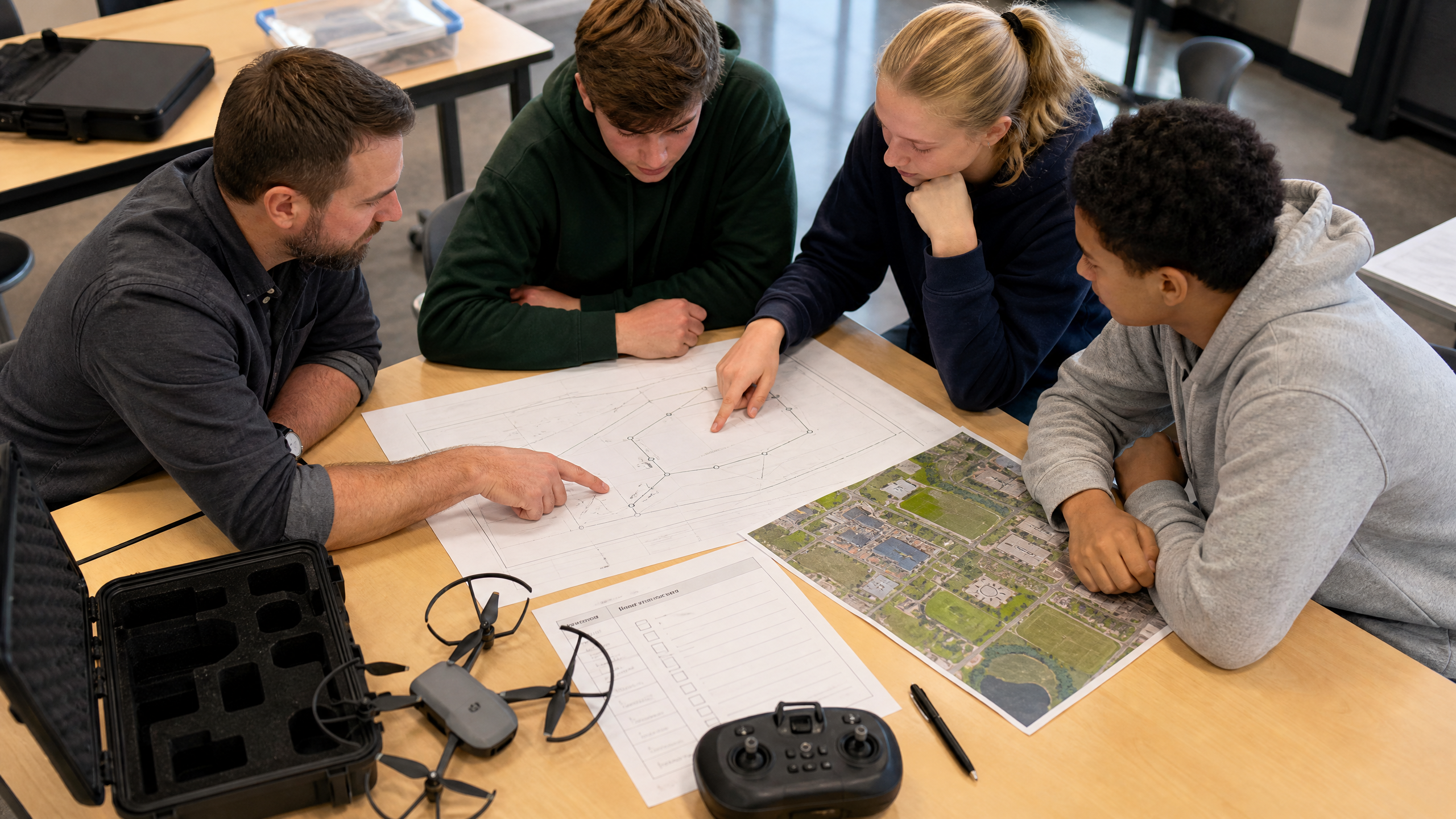
A strong final project asks students to solve a realistic problem. For example, a team might design a drone mission for a school facilities inspection scenario, a mock agricultural field survey, or an emergency response planning exercise. The deliverable could include a mission brief, a safety plan, a flight area diagram, sample data outputs, and a reflection on relevant careers. This type of assessment gives teachers evidence of technical learning while giving administrators a clear picture of employability skills.
A Practical First-Semester Implementation Roadmap
Schools can start small and still build a professional-quality pathway. During weeks one and two, focus on safety culture, vocabulary, classroom procedures, and basic drone anatomy. During weeks three through five, introduce controlled indoor flight skills and crew roles. During weeks six through eight, teach airspace, weather, and mission planning fundamentals. During weeks nine through eleven, connect drones to data collection, mapping concepts, and industry use cases. During weeks twelve through fourteen, introduce FAA Part 107 concepts in context. During the final weeks, students complete a scenario-based project and present a career pathway connection.
Bring Drone Curriculum to Your School
See how Drone Launch Learning can help your educators build a practical, career-connected drone program.
This sequence gives educators enough structure to avoid the common mistake of starting with unstructured flying. It also gives students repeated opportunities to connect classroom learning to authentic decisions. Most importantly, it creates a foundation that can grow. In year two, schools can add advanced mapping, coding, industry speakers, internships, dual enrollment, or credential preparation.
Key Takeaways
- A high school drone curriculum should teach safety, regulations, flight skills, systems, data, and careers.
- Part 107 concepts are most effective when taught through mission scenarios, not isolated memorization.
- Schools can start with small indoor drones before expanding into advanced aircraft or outdoor operations.
- Drone education supports multiple CTE pathways, including agriculture, construction, public safety, STEM, and IT.
- The strongest programs assess student planning, teamwork, documentation, and professional judgment.
Bring Drone Curriculum to Your School With Confidence
A well-designed high school drone curriculum gives educators a powerful way to make STEM and CTE learning visible. Students are not just reading about technology; they are planning missions, making safety decisions, interpreting real-world constraints, and seeing how classroom knowledge connects to future careers. For schools, the opportunity is to create a pathway that is engaging, practical, and aligned with the expectations of modern technical fields.
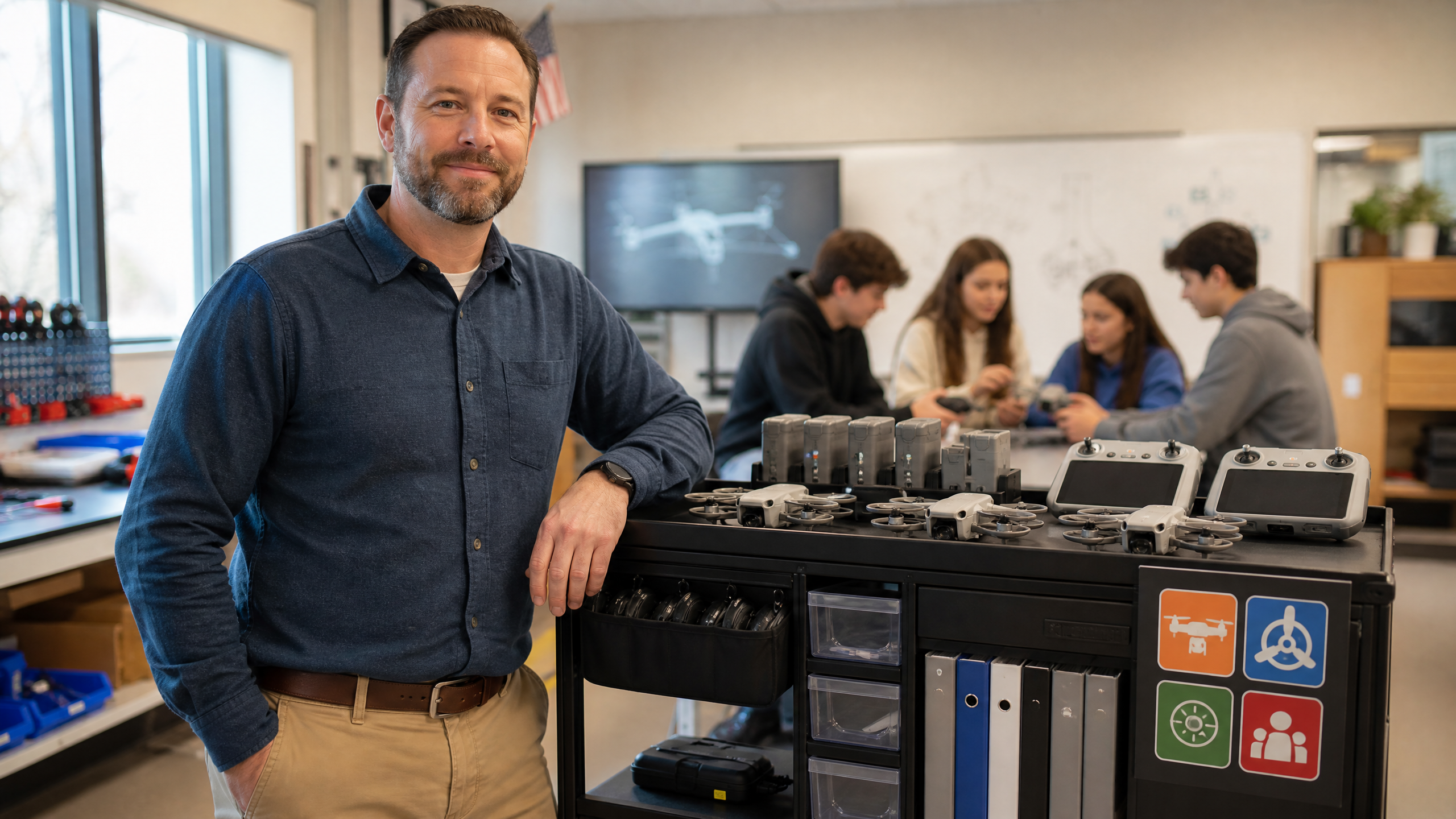
If your school is exploring drone curriculum, the best next step is to clarify your goals. Decide whether you need an introductory unit, a semester elective, a full CTE course, or a certification-oriented pathway. Then build the program around safety, teacher support, and student outcomes. With the right structure, drones can become more than an exciting classroom tool. They can become a bridge between academic learning and meaningful career readiness.
Ready to launch a drone curriculum at your school?
Drone Launch Learning helps educators build practical, career-connected drone programs for CTE and STEM classrooms.
References
[1] Federal Aviation Administration, Certificated Remote Pilots including Commercial Operators.
[3] Virginia CTE Resource Center, Unmanned Aircraft Systems.