Drone Curriculum Lesson Plans for High School: A CTE Guide for Educators
Effective drone curriculum lesson plans for high school work best when they are designed as a career-connected learning experience, not as a stand-alone flight activity. For teachers, CTE directors, and administrators, the practical question is not simply which drones to buy. It is how to build a sequence that teaches safety, technical knowledge, operational judgment, and professional communication while fitting a real bell schedule. A well-scoped program can give students a concrete way to apply STEM concepts, explore aviation and technology roles, and produce evidence of learning that school leaders can recognize.
That approach also keeps the program grounded. The FAA describes drones as useful tools in education and provides resources for educators and students exploring aviation and aerospace. Its STEM aviation education work emphasizes hands-on learning, career awareness, and collaboration with educators and industry. A school program can use that context to make every lesson purposeful: students learn what safe operations require, how a mission is planned, and how technical choices affect outcomes.
Begin With the Learning Outcome—not the Aircraft
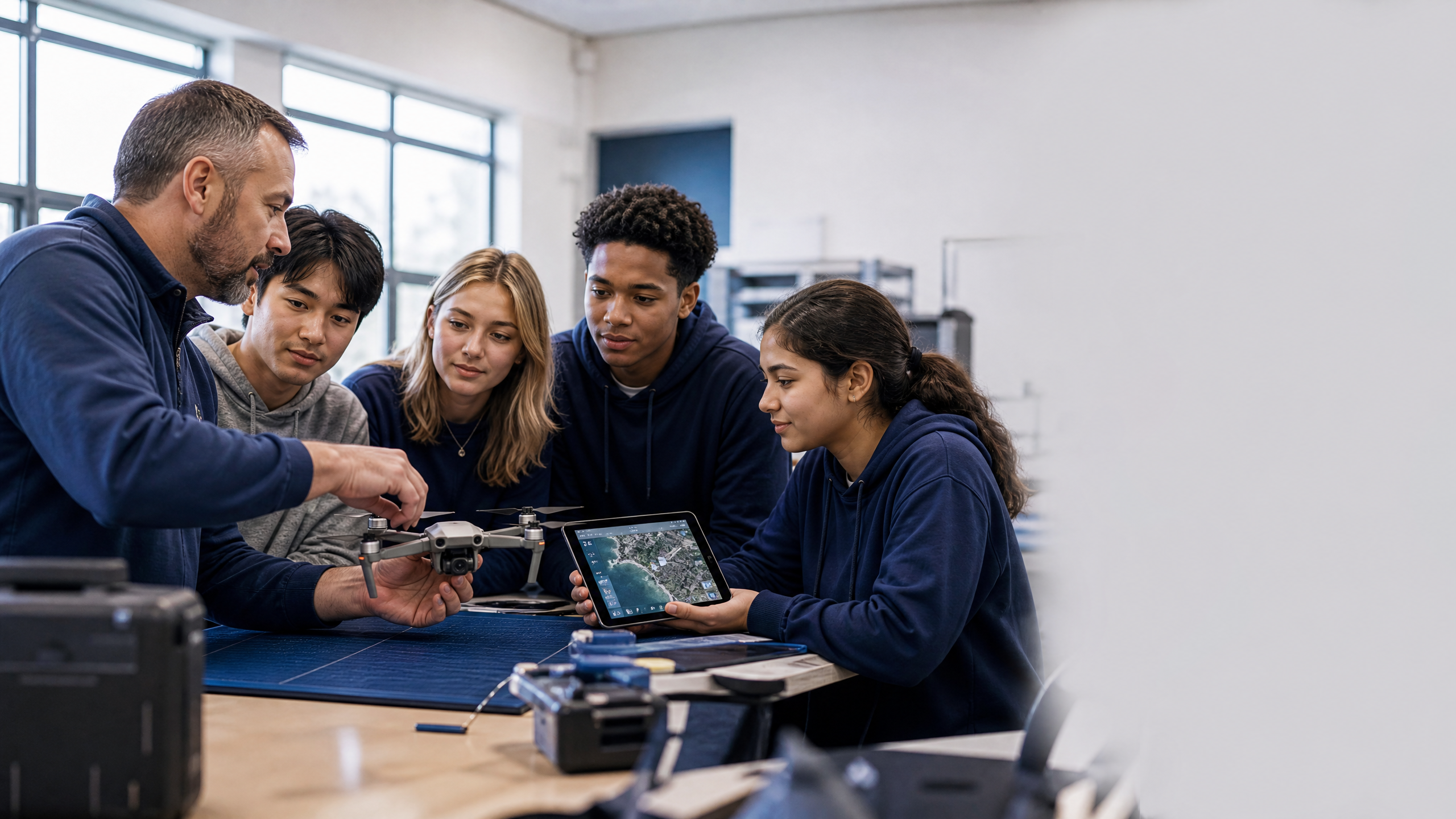
Before selecting curriculum materials or equipment, define what a successful learner should be able to do by the final week. Most schools begin with one of three outcomes. An introductory STEM experience builds foundational vocabulary and confidence with aviation technology. A CTE pathway adds applied technical skills, project evidence, and career exploration. A more advanced sequence can prepare eligible students to study for the FAA Part 107 knowledge test while still preserving classroom time for practical decision-making and documentation.
Each outcome calls for a different balance of theory, practice, and assessment. A short exploratory unit may emphasize systems, safety, and a supervised flight exercise. A semester CTE course can add mission briefs, maintenance checks, data workflows, and a career-facing capstone. Part 107 preparation should be positioned accurately: it introduces knowledge areas relevant to the FAA test, but it does not replace the federal requirements a student must meet to become a Remote Pilot. In the United States, candidates must be at least 16 to earn a Remote Pilot certificate. Build the course promise around the learning students will demonstrate, rather than around a label that the course alone cannot confer.
Build the Curriculum Around Five Connected Strands
The most durable drone courses revisit a few essential strands throughout the term. First, students need a practical understanding of aviation safety and the operating environment. This includes airspace awareness, weather, visual line of sight, people and property considerations, and local school procedures. Second, they should understand the system itself: aircraft components, batteries, sensors, controllers, basic troubleshooting, and care. Third, learners need operational habits such as pre-flight inspections, crew roles, communication, and post-flight documentation.
The fourth strand is application. Drones have value because they support work such as visual media, inspection, mapping, environmental observation, public safety support, and construction documentation. Educators do not need to simulate every industry; instead, they can use a few well-designed scenarios to show how a mission objective influences payload choices, flight planning, risk controls, and deliverables. The fifth strand is professional communication. Students should explain what they planned, what they observed, what changed, and what evidence supports their recommendation. That habit turns a flight exercise into CTE-quality work.
What a Strong Lesson Plan Looks Like
For everyday classroom use, each lesson should make the connection between knowledge and application explicit. A concise plan can begin with a driving question, name the standard or pathway skill being addressed, introduce one concept, and give students a defined task with an observable output. In a lesson on weather, for example, learners might interpret a forecast, identify the operational implications, and defend a go/no-go decision in a short mission brief. In a lesson on batteries, they might create a charge-management checklist and explain how it protects both people and equipment. The output matters because it gives the teacher a way to assess reasoning before a flight occurs.
It also helps to separate activities into three levels. First, use low-risk knowledge checks and simulations to build vocabulary and decision habits. Next, use guided practical exercises with clearly assigned roles. Finally, ask teams to synthesize their work in an applied scenario. This gradual release keeps novice learners from being overwhelmed by aircraft controls while giving experienced learners an opportunity to demonstrate leadership. It also creates a useful substitute when weather, space, staffing, or equipment availability changes at the last minute: the learning sequence can continue even when an outdoor flight cannot.
“The strongest drone courses do not treat flight as the finish line; they use flight as evidence that students can make sound operational decisions.”
Make Safety and Compliance a Routine, Not a Single Lesson
Safe operation should appear in every practical lesson, even when students are working with lightweight training aircraft. The FAA explains that registration rules, operating rules, and airspace requirements vary with the operation and aircraft. Its registration guidance says that all drones must be registered except those weighing 0.55 pounds (250 grams) or less that are flown under the Exception for Limited Recreational Operations; Part 107 operations have different registration requirements. Educators should use current FAA guidance and their district’s policies when planning activity details, rather than relying on an old slide deck or a one-time briefing.
Educational purpose alone does not determine the operating framework. The FAA’s guidance for educational users explains that drones used for education are regulated under either the limited recreational exception or the Small UAS Rule, and that many educational organizations must be chartered by an FAA-recognized community-based organization to use the exception. Programs that do not qualify must operate under Part 107. Treat this as a planning prompt, not a classroom footnote: confirm the applicable framework, permissions, and procedures before operating.
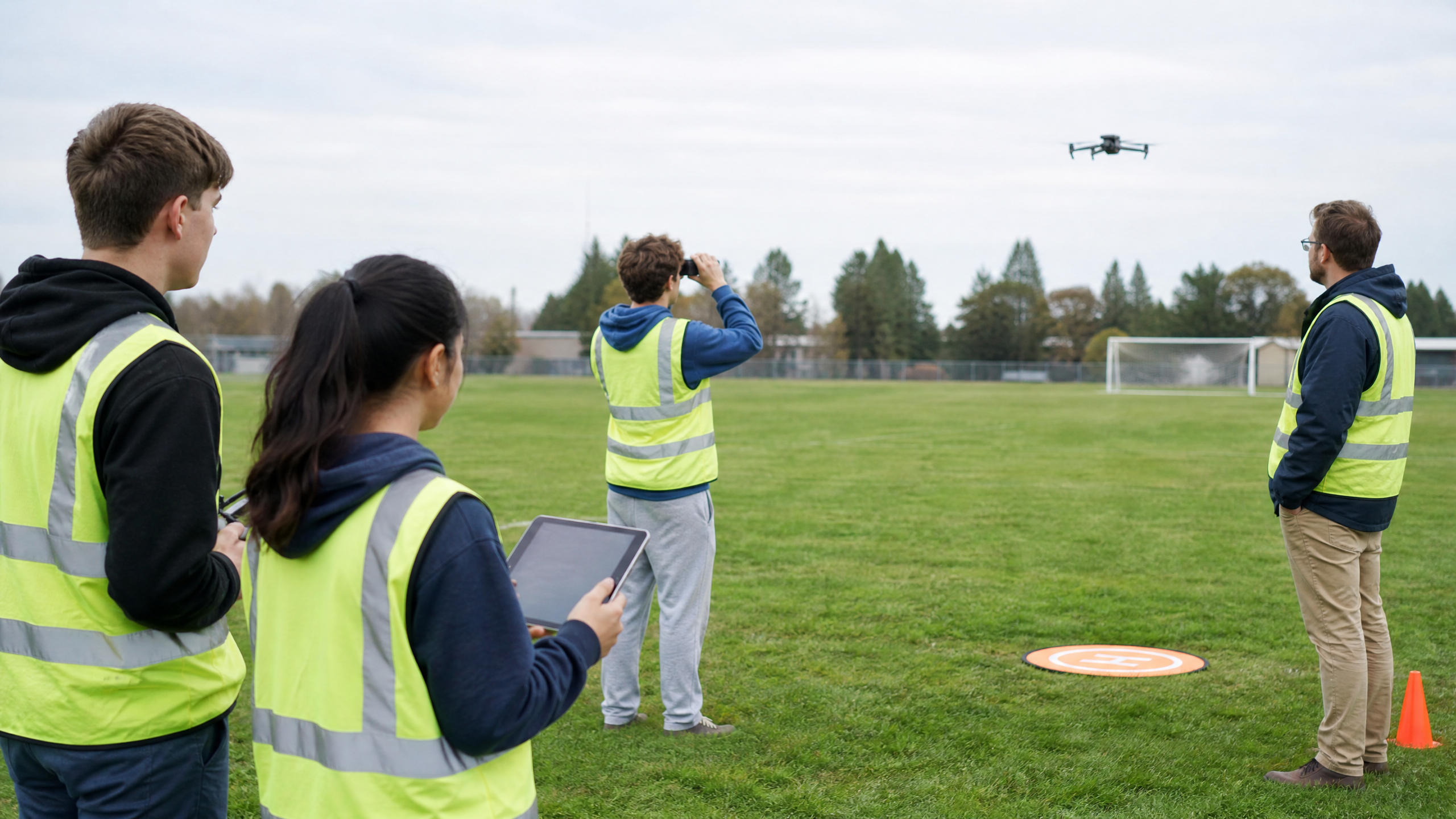
In class, the routine can be simple and repeatable: assign roles, inspect the aircraft and space, name the objective, check the conditions, decide whether to proceed, conduct the exercise, and debrief. This structure teaches students that a professional flight begins before takeoff and ends after the aircraft is packed away. It also gives instructors a clear way to pause an activity when conditions are not right. Use flight logs, incident-free debriefs, and reflection prompts to show that learners understand why a decision was made—not merely that they can manipulate controls.
Design a Semester That Works With Your Bell Schedule
Implementation becomes easier when the course has a predictable rhythm. Drone Launch Learning describes flexible school delivery in roughly 9–18-week formats, with about 3–5 instructional hours per week depending on the setting. That range is a useful planning benchmark, not a mandate. A CTE director can build a 9-week exploratory module around safety, systems, and one applied project, while a longer semester can add more mission planning, credential preparation, and student portfolio work.
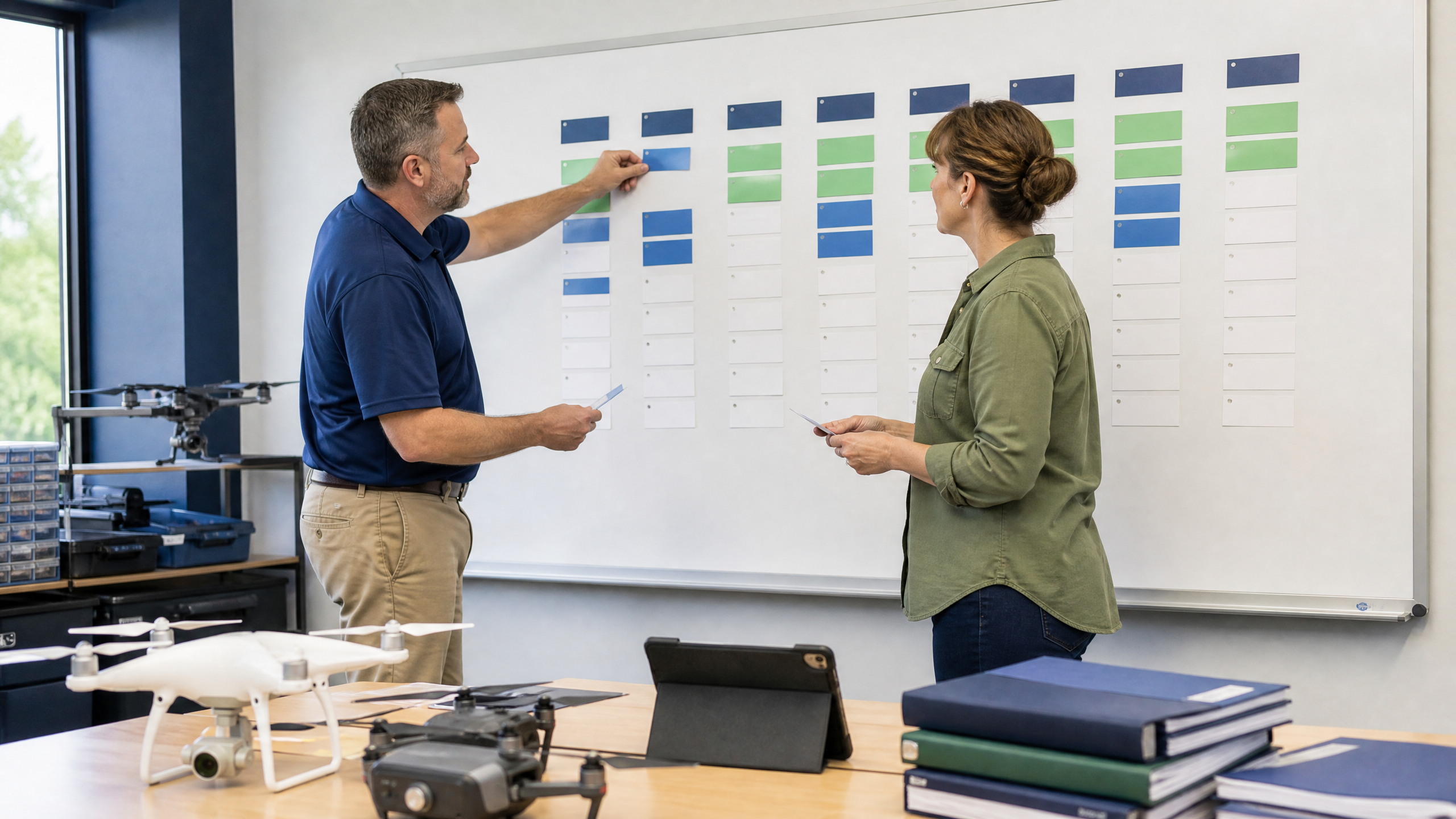
A practical sequence begins with orientation and safety norms, then moves into systems knowledge and controlled skill practice. In the middle of the term, students apply those foundations to a structured mission scenario. The final phase focuses on evidence: a presentation, mission packet, reflection, or demonstration that shows how the team made decisions. Reserve readiness gates between phases. A student should demonstrate the expected knowledge, role awareness, and safety behavior before progressing to a more complex activity. These gates protect instructional time because teachers do not need to reteach the whole class after an avoidable error.
Turn Career Exploration Into Evidence Students Can Show
Career connection should be specific enough for students to see how classroom work translates beyond school. A media-oriented mission might ask a team to plan safe aerial coverage for a school event and explain the permissions, shot list, and risk controls. An engineering-oriented task might compare aircraft components, evaluate battery management practices, and propose a maintenance procedure. A geospatial or environmental scenario might focus on planning observations and presenting findings responsibly without overstating what the data can prove.
These scenarios connect to roles in operations, engineering and maintenance, content production, construction documentation, public safety support, environmental work, and aviation-adjacent technology. They also reinforce skills that transfer across pathways: reading requirements, collaborating, documenting work, using technology responsibly, and presenting a recommendation. The FAA’s education program highlights career exploration from aviation through engineering and technician roles, which helps schools place drone learning within a broader aerospace conversation rather than treating it as an isolated trend.
Build a Stronger Drone Learning Pathway
Explore educator-focused curriculum and implementation support designed for real CTE and STEM classrooms.
Choose Resources That Help Teachers Teach
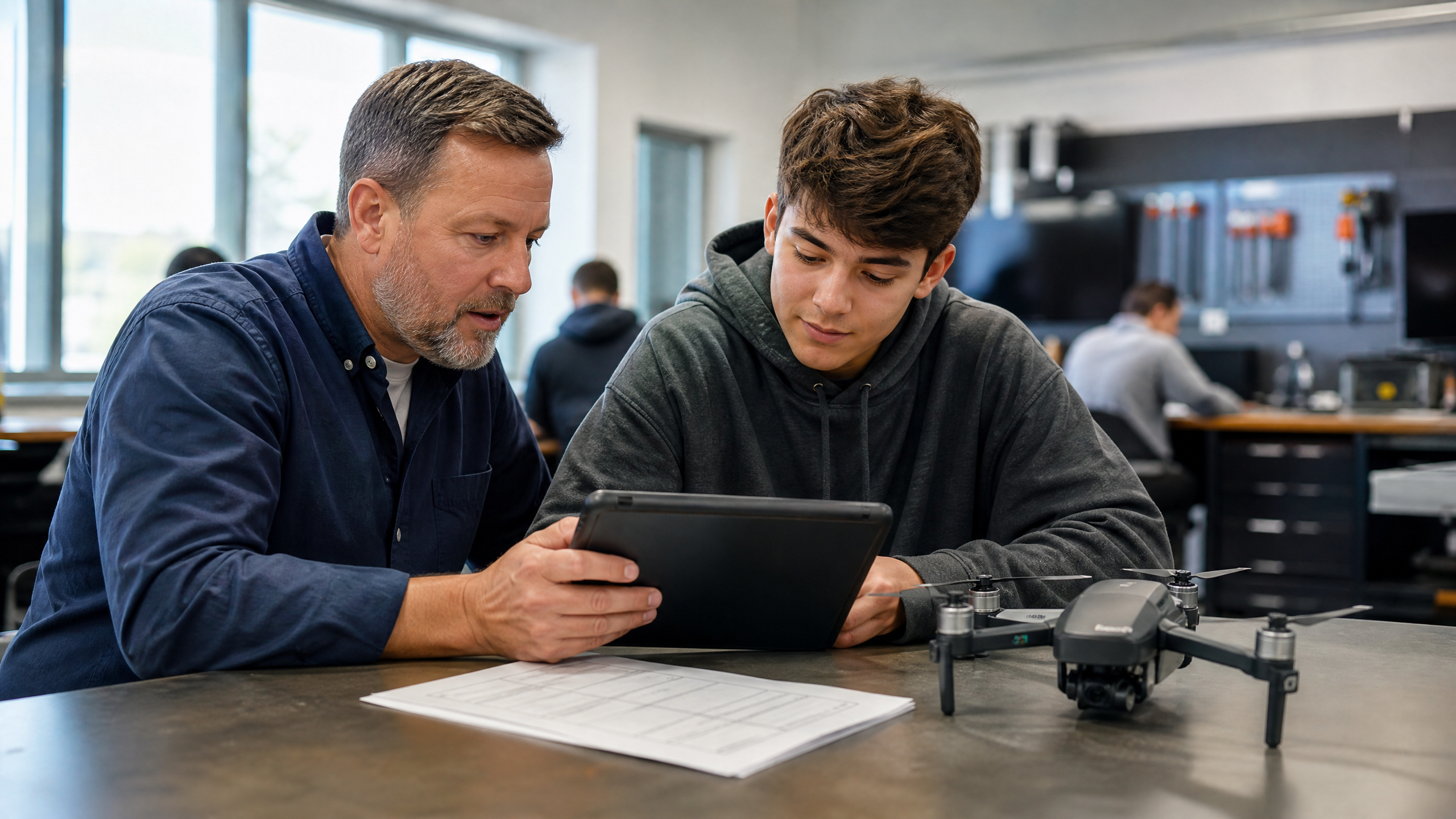
Schools do not need a teacher who is already an expert pilot to start a thoughtful program. They do need resources that make implementation dependable. When evaluating a high school drone curriculum, look for teacher-facing pacing guidance, clearly sequenced lessons, standards or pathway alignment notes, assessments, student-friendly explanations, and support for classroom management. Ask how a lesson works when weather changes, when a school has limited flying space, or when a class needs a more accessible entry point. A resource is classroom-ready only when it anticipates those realities.
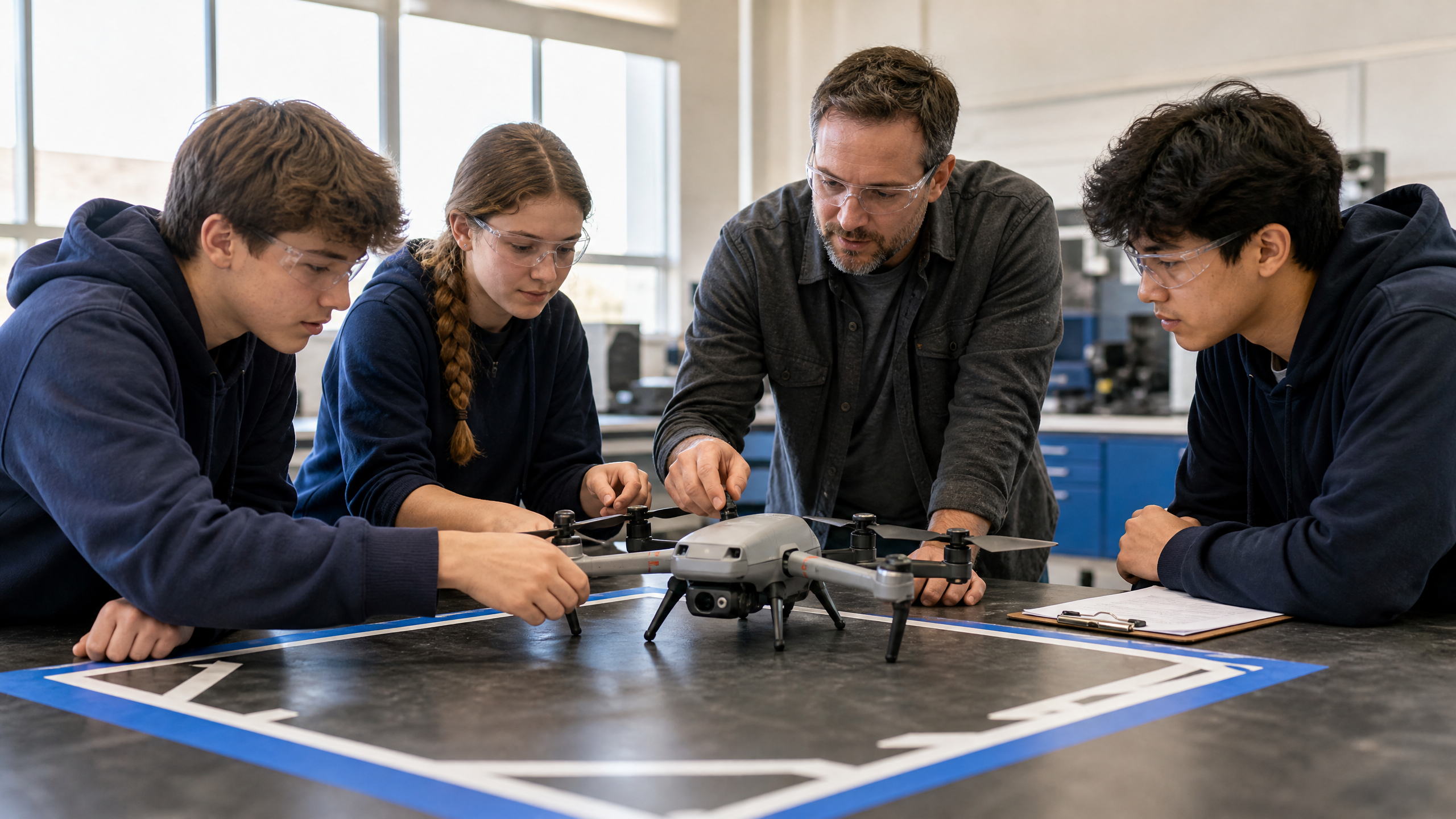
Equipment planning should follow the course design. Choose training aircraft and activities that fit the learning level, available space, staff capacity, and district requirements. The goal is not to create a one-to-one relationship between student and aircraft. A team structure can be stronger: one student leads the checklist, another acts as visual observer, another tracks the mission plan, and another manages documentation. Drone Launch Learning recommends a planning ratio of approximately three students per drone for many classroom settings. Roles let every learner contribute even when only one aircraft is flying.
Use Simple Measures to Improve the Program Each Term
A leadership update should show more than how many students flew a drone. Track course completion, readiness-gate performance, safety-routine fidelity, quality of mission artifacts, student reflection, credential readiness where applicable, and participation in follow-on pathways. These measures help educators identify whether the challenge is pacing, content, equipment access, or support—not simply student interest. They also give administrators useful evidence when they are considering how drone education fits into STEM, CTE, aviation, engineering, or work-based learning priorities.
Prepare Staff and Stakeholders Before the First Flight
Successful implementation is a shared responsibility. Before the course starts, identify the instructional lead, campus contacts, supervision expectations, location options, storage procedures, and the approval process for practical activities. Then make those decisions visible in a one-page operating plan. A short overview can state the course outcome, the typical lesson format, the safety routine, the role of adult supervision, and the artifacts students will create. This is more useful than a broad promise that the program will be innovative; it gives administrators and families concrete evidence of how the learning experience is managed.
Invite relevant CTE and community partners to review the work students will produce, not merely to watch a demonstration. An advisory member can react to a student mission brief, offer feedback on a presentation, or describe how documentation is used in a related field. Their participation reinforces professional expectations without turning the course into job-specific training for a single employer. It also helps schools keep their curriculum current as technology and local pathway priorities evolve. When educators, leaders, and partners understand the sequence, a high school drone curriculum is easier to sustain from one term to the next.
Launch With a Clear, Repeatable Plan
The best drone curriculum lesson plans for high school are ones that educators can deliver consistently and students can connect to meaningful work. Start with the outcome, build recurring safety and decision-making routines, and select scenarios that produce visible evidence of learning. Then choose teacher-ready resources that fit the pace, personnel, and procedures of your school. With that foundation, drones become more than an engaging technology; they become a structured way to teach responsibility, technical fluency, and career-connected problem solving.
Key Takeaways
- Start with the career and learning outcome, then select the course model.
- Treat safety and operational judgment as recurring skills, not an opening lesson.
- Use logs, briefs, and demonstrations to show CTE evidence.
- Plan a flexible 9–18 week pace with defined readiness gates.
- Choose teacher-ready resources that align to your schedule and implementation capacity.
Ready to build a classroom-ready drone pathway?
Book a demo to explore educator-focused curriculum, teacher support, and a launch plan that fits your school.