

Drone Curriculum for High School CTE Programs: A Practical Guide for Educators
A strong drone curriculum for high school CTE programs should combine FAA-aligned safety instruction, hands-on flight practice, mission planning, data capture, career exploration, and teacher-ready implementation support. For CTE directors, STEM coordinators, and school administrators, the goal is not simply to buy drones. The goal is to build a safe, repeatable, career-connected learning pathway that teachers can actually deliver and students can connect to real technical work.
Drones are especially valuable in CTE because they sit at the intersection of aviation, robotics, geospatial technology, data analysis, public safety, agriculture, construction, and media production. The Federal Aviation Administration notes that drones can be used in education and that educational operations may fall under either the Exception for Limited Recreational Operations or the Small UAS Rule, depending on the organization and use case [1]. That makes curriculum design important: the lessons must teach students how to fly, but also why rules, airspace, weather, documentation, and safety culture matter.

Key Takeaways
- A drone curriculum should blend safety, FAA literacy, hands-on missions, and career context.
- CTE leaders should evaluate teacher support, equipment guidance, and assessment tools before purchasing.
- FAA rules matter because school programs may operate under educational exceptions or Part 107 depending on context.
- Drone learning connects to aviation, geospatial, public safety, agriculture, construction, and data careers.
- A phased launch helps schools start safely and scale without overwhelming teachers.
Why Drone Curriculum Belongs in High School CTE Now
High school CTE programs are strongest when students see a direct line between classroom learning and the workplace. Drone education creates that line because students do not only learn to operate a device. They learn how to plan a mission, assess risk, interpret maps, understand weather, collect usable information, communicate as a crew, and document results. Those skills transfer across multiple career clusters, including transportation, STEM, information technology, architecture and construction, agriculture, natural resources, and public safety.
The case for drone curriculum is also supported by national aviation and labor trends. The FAA’s aerospace forecast page identifies Unmanned Aircraft Systems and remote pilots as part of its aviation forecasting work [2]. In its UAS and Advanced Air Mobility forecast materials, the FAA reported more than 842,000 commercial small UAS observed in 2023 and projected a recreational small UAS base-case fleet of about 1.88 million units by 2028 [3]. At the same time, adjacent data careers are expanding: the Bureau of Labor Statistics projects 34 percent growth for data scientists from 2024 to 2034 [4], while cartographers and photogrammetrists are projected to grow 6 percent over the same period [5].
For educators, these numbers should not be treated as a promise that every student will become a drone pilot. Instead, they show why drones are a useful instructional platform. A single mission can involve aviation vocabulary, physics, coordinate systems, team communication, data ethics, technical writing, and visual storytelling. That breadth makes drones a practical tool for schools that want CTE pathways to feel modern without losing academic rigor.
What Makes a Drone Curriculum CTE-Ready?
A CTE-ready drone curriculum is more than a sequence of fun flight activities. It should be organized around measurable competencies, safety routines, teacher supports, and student evidence of learning. Administrators should look for lesson plans that include clear objectives, vocabulary, materials lists, pacing, checks for understanding, and assessment rubrics. Teachers should be able to open a unit and understand what to teach before, during, and after flight time.
Curriculum Fit Check
The best curriculum is not simply a flight manual. It should help teachers teach safety, regulations, mission planning, data, teamwork, documentation, and reflection in a repeatable classroom structure.
The curriculum should also support employability skills. Students should practice crew roles, preflight briefings, communication protocols, maintenance logging, troubleshooting, and post-mission reporting. These routines help a school shift drone learning from novelty to professional preparation. A grounded drone on a desk can be just as valuable as a drone in the air if students are learning inspection, battery management, mission constraints, or risk assessment.
FAA and School Compliance Basics Educators Should Understand
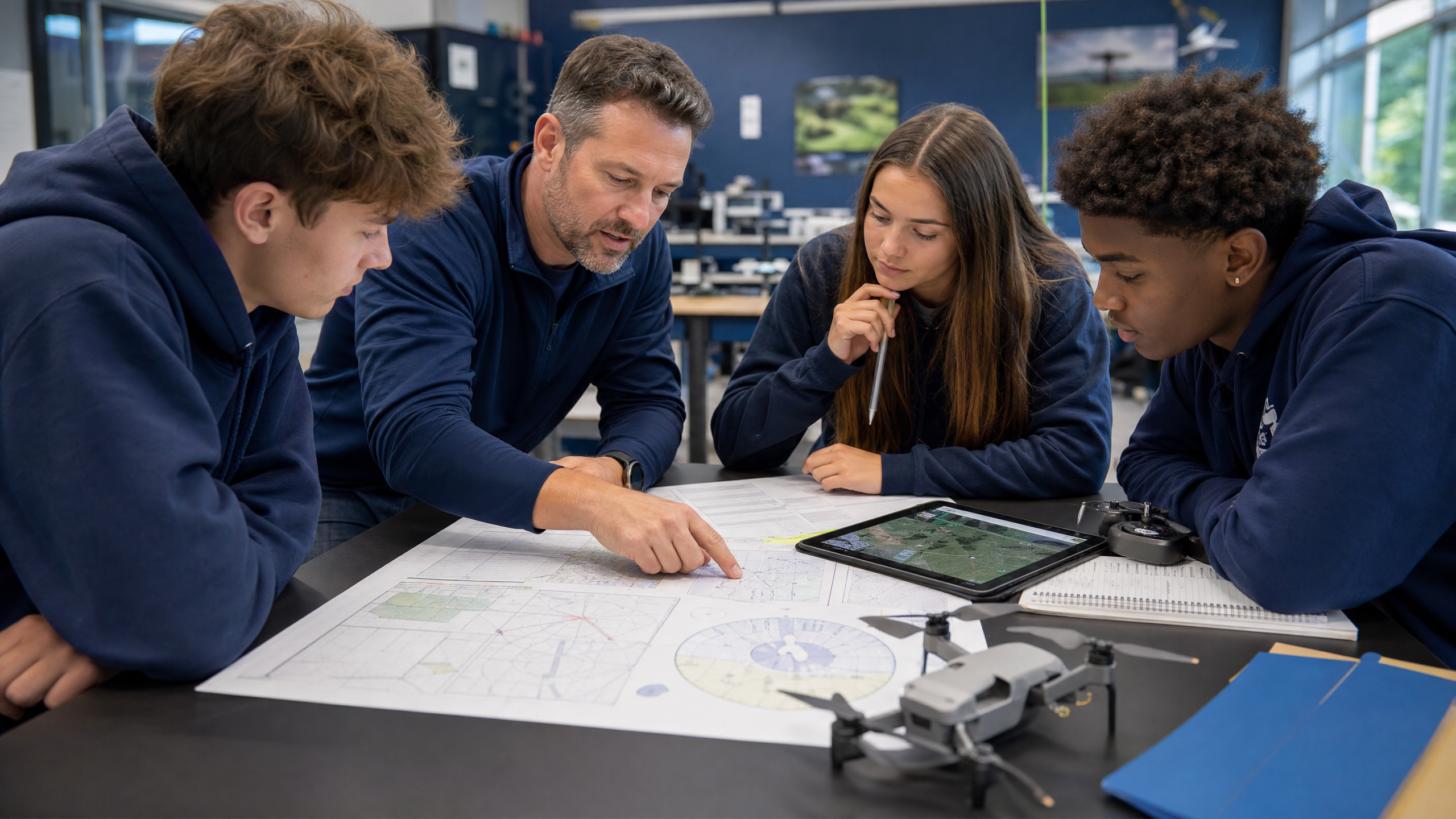
Schools do not need to turn every teacher into an aviation attorney, but every program needs a basic compliance framework. The FAA states that educational drone use is regulated either under the Exception for Limited Recreational Operations or under Part 107, the Small Unmanned Aircraft Systems Rule [1]. The same FAA guidance explains that qualifying educational organizations may operate under the educational and research provisions of Section 44809 in certain situations, while other organizations must operate under Part 107 [1]. Because school context matters, districts should confirm their operating model before outdoor flight.
A school drone program is strongest when safety and compliance are designed into the curriculum before the first flight, not added after an incident or audit.
Part 107 is important because it is the primary FAA rule for many non-recreational small drone operations. The FAA explains that a person flying under Part 107 must obtain a Remote Pilot Certificate, be at least 16 years old, be able to read, speak, write, and understand English, and pass the initial aeronautical knowledge exam [6]. The FAA also states that certificate holders must complete recurrent training every 24 calendar months to maintain aeronautical knowledge recency [6]. Even when students are not immediately pursuing certification, Part 107 vocabulary gives the course professional relevance.
Core Modules Every High School Drone Pathway Should Include
The best drone pathways move from foundational safety to applied missions. Students should first learn how to handle equipment, charge batteries, inspect aircraft, manage a flight area, and communicate as a crew. Only then should they move into more complex flight tasks, outdoor planning, data capture, and capstone projects. A pathway can begin in a semester course, expand into a yearlong CTE sequence, or serve as a module inside aviation, engineering, robotics, agriculture, or computer science.
| Module | What Students Learn | CTE Evidence of Learning |
|---|---|---|
| Safety and preflight | Checklists, crew roles, battery handling, emergency procedures | Completed safety brief and preflight log |
| FAA literacy | Airspace, Remote ID concepts, operating categories, Part 107 vocabulary | Scenario-based compliance reflection |
| Aircraft systems | Frames, motors, sensors, controllers, payload limits, maintenance | Inspection worksheet or maintenance note |
| Flight skills | Orientation, hovering, patterns, precision movement, crew communication | Teacher-observed skills rubric |
| Mission planning | Objectives, site review, weather, risk controls, data needs | Mission plan and go/no-go decision |
| Data and careers | Imagery, mapping, interpretation, reporting, career applications | Student presentation or technical report |
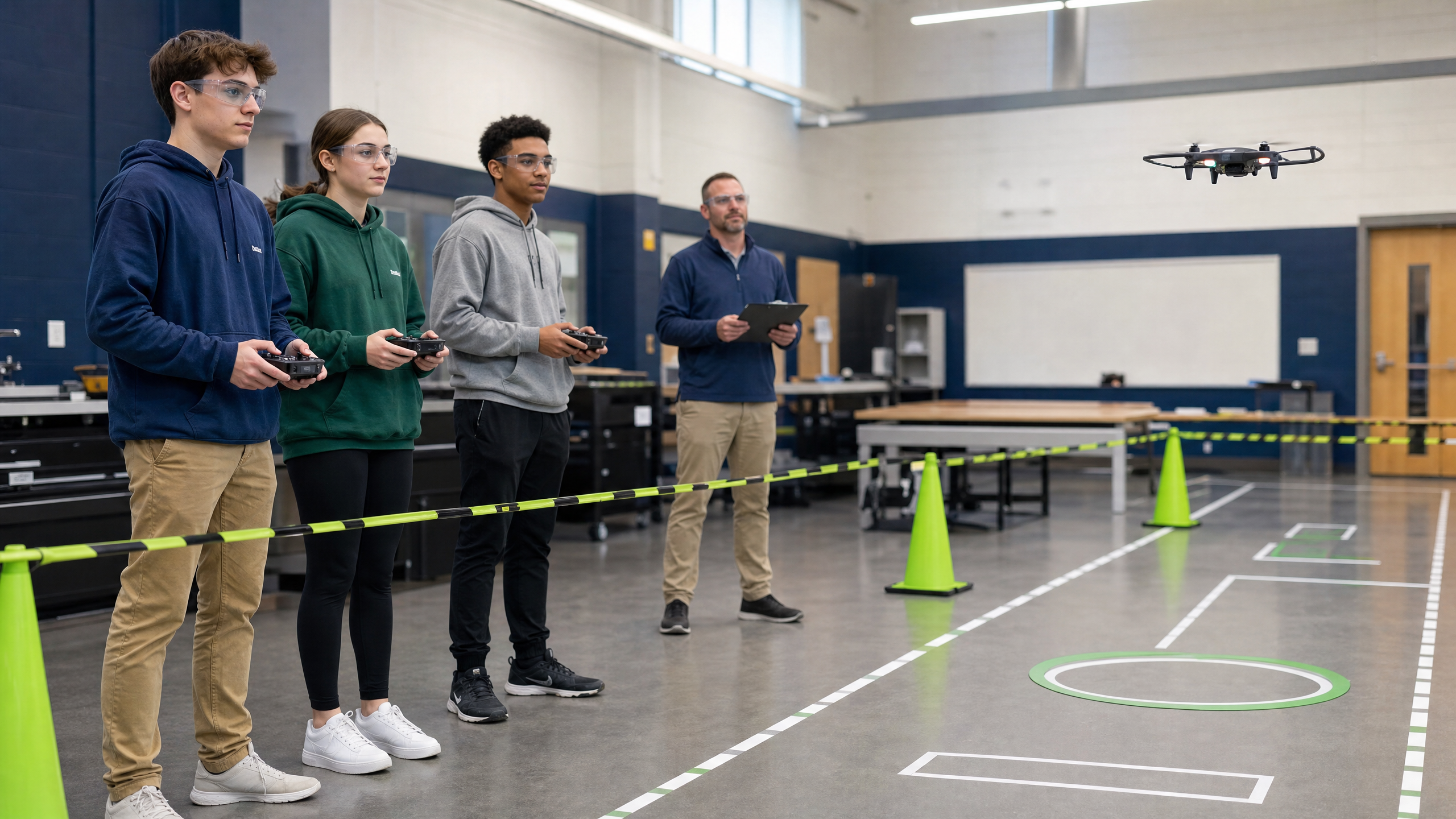
This structure keeps the course balanced. It prevents a common implementation problem: students fly before they understand why flight discipline matters. It also helps teachers who are new to drones by giving them a repeatable sequence rather than a box of equipment and a vague expectation to “do STEM.”
How to Evaluate Curriculum Before Buying
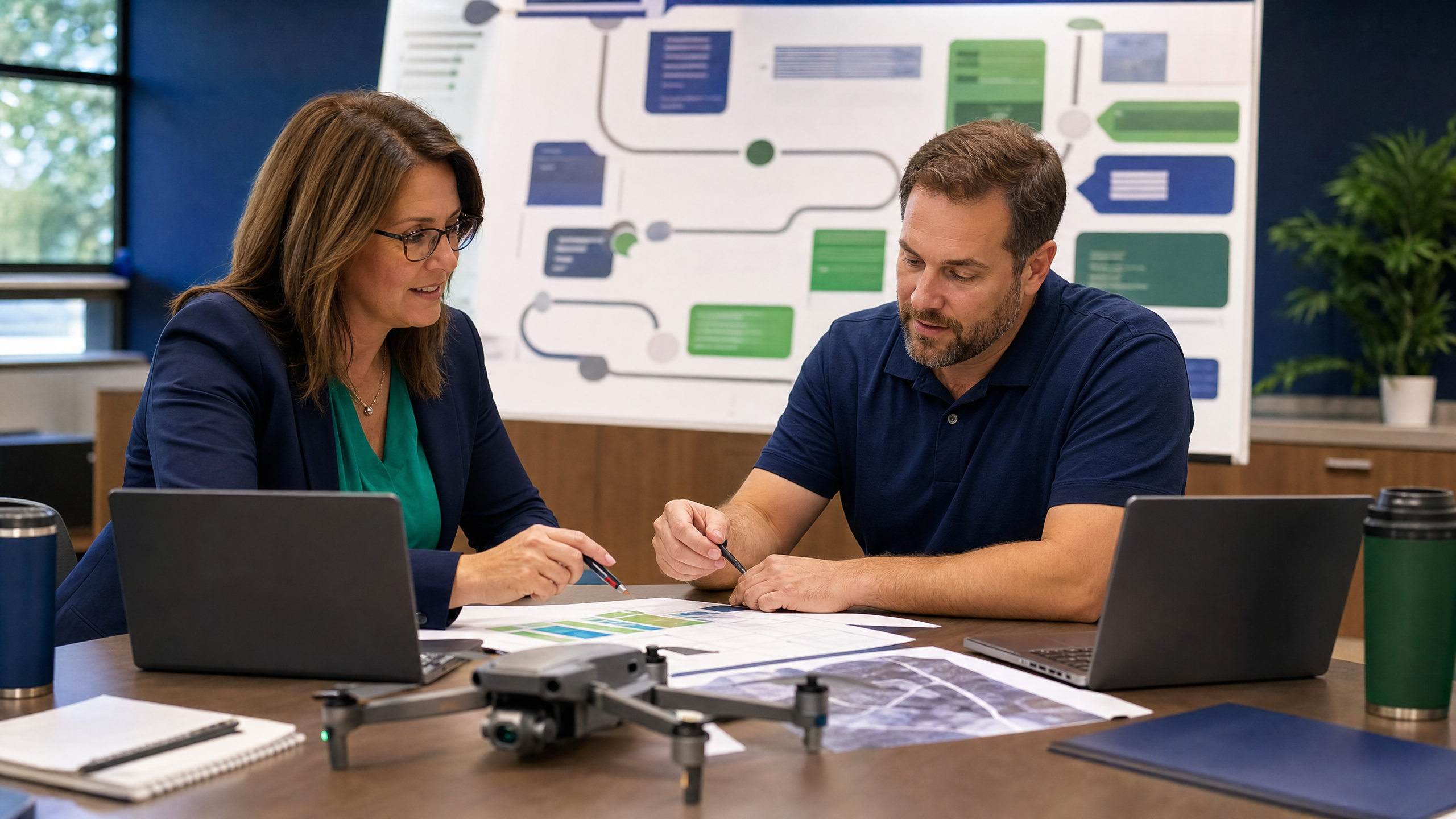
Before choosing a drone curriculum for high school CTE programs, administrators should ask whether the program is teacher-ready, standards-conscious, and realistic for the school environment. A polished product page is not enough. The curriculum should explain what equipment is needed, how many students can participate at once, how flight activities are managed, what happens when weather prevents outdoor work, and how learning is assessed.
Evaluation should also include teacher confidence. If a teacher has never taught aviation, the program should provide vocabulary support, pacing guidance, safety protocols, implementation coaching, and examples of student work. If a teacher already has drone experience, the curriculum should still save planning time and create consistency across classrooms, campuses, or district sites.
Administrator Tip
Ask vendors how they support teachers who are new to aviation. A strong program should include implementation guidance, safety protocols, vocabulary support, and practical project examples.
A strong review process should examine ten areas: safety documentation, FAA literacy, teacher pacing guides, assessment tools, indoor and outdoor activity options, equipment guidance, student collaboration structures, career pathway connections, differentiation, and support after purchase. The best curriculum makes the program easier to operate in year two than it was in year one because materials, routines, and expectations are already documented.
A Phased Implementation Plan for Schools
Launching a drone program works best when schools phase the work. Phase one is planning: identify the course home, teacher lead, administrative sponsor, safety expectations, and likely flight environments. Phase two is teacher readiness: build comfort with equipment, lesson pacing, vocabulary, and classroom management. Phase three is non-flight instruction and simulation, where students learn safety, rules, parts, and mission planning before live operations.
Phase four introduces indoor flight labs with small aircraft, defined boundaries, and visible safety routines. Phase five adds outdoor missions only after the school has confirmed its operating model, site procedures, weather rules, and supervision plan. Phase six expands into capstones, community-connected projects, career exploration, and potentially certification preparation. This phased approach reduces risk while helping administrators build confidence that the program can scale.
Want a Drone Curriculum Your Teachers Can Launch With Confidence?
See how Drone Launch Learning helps educators build safe, structured, career-connected drone programs for CTE classrooms.
Budget, Equipment, and Classroom Management Considerations
Schools should treat drone equipment as an instructional system, not a one-time gadget purchase. A starter program may need durable training drones, spare propellers, batteries, charging procedures, storage, safety glasses, landing pads or cones, maintenance logs, and a system for tracking aircraft condition. Teachers also need a plan for what non-flying students do while one crew is operating. Without stations, roles, and assignments, flight days can become inefficient.
Budget planning should also include replacement parts, battery lifecycle, teacher training time, and administrative coordination. Schools should consider whether the curriculum is equipment-neutral or locked to a specific drone model. Equipment-neutral lessons can help districts adapt as technology changes, while still maintaining a consistent instructional sequence.
Career-Connected Outcomes to Build Into the Program
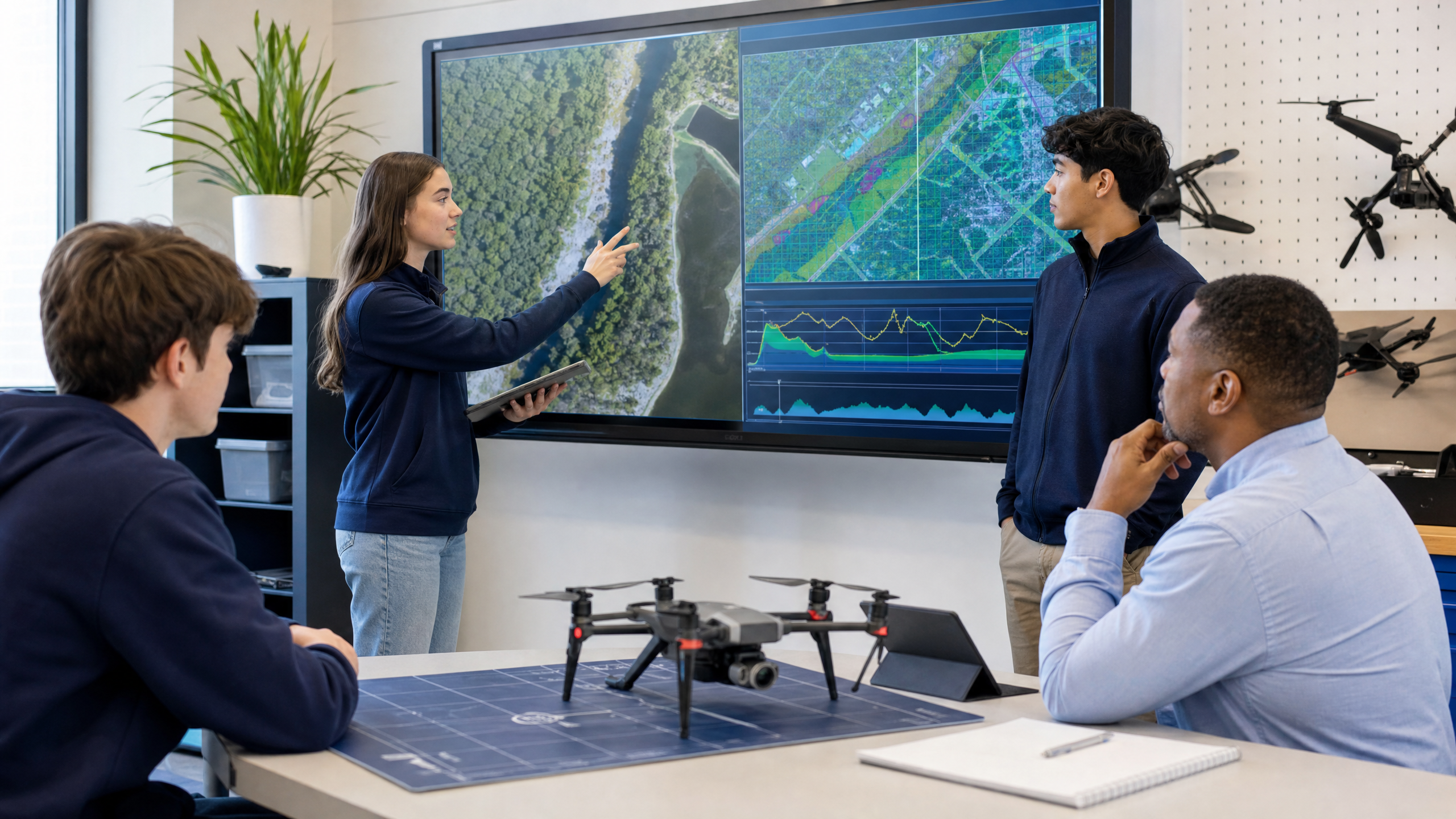
Drone curriculum becomes more powerful when students create artifacts that resemble workplace deliverables. A public safety scenario might require a search pattern plan and incident briefing. An agriculture scenario might ask students to interpret field imagery. A construction scenario might involve progress documentation. A media scenario might require shot planning and ethical decision-making. A geospatial scenario might connect imagery to mapping and analysis.
The FAA’s Youth Drone Initiative is designed to connect youth organizations, schools, industry, and government agencies while supporting drone aviation as a workforce pathway alongside traditional aviation careers [7]. That is exactly the kind of connection CTE programs should emphasize. Students should leave the course with more than flight time. They should leave with documentation, presentations, mission plans, and a clearer understanding of how drone skills relate to real jobs.
Final Recommendation for Educators
If your school is evaluating a drone curriculum for high school CTE programs, choose the option that makes safe implementation easier, not just the option that looks exciting. The right curriculum should help teachers explain regulations, run structured labs, connect missions to careers, assess student growth, and build a program that administrators can support with confidence.
Drone education works because it makes technical learning visible. Students can see the aircraft, plan the mission, gather information, analyze results, and explain their decisions. For CTE leaders, that creates a rare combination: engagement, rigor, safety, and workforce relevance in one pathway. With the right structure, a drone program can become more than a classroom innovation. It can become a durable part of a school’s career-connected learning strategy.
Ready to Build a Drone Program Educators Can Actually Teach?
Book a demo with Drone Launch Learning to see how a structured drone curriculum can support CTE teachers, administrators, and career-connected student outcomes.