
Choosing a drone curriculum for high school is a program-design decision, not simply an equipment decision. CTE leaders need a learning experience that can stand up to a real bell schedule, a real risk-management process, and a real expectation for career-connected learning. The right curriculum helps educators teach aviation knowledge, build operational habits, create meaningful projects, and document readiness without turning a new pathway into a collection of disconnected activities.
A practical way to evaluate options is to ask seven questions: What outcome are we building toward? How are safety and compliance taught? Is instruction sequenced? Can the program work in our setting? Does it connect to an existing pathway? How will we assess it? And what support makes implementation sustainable? This guide walks through each question so administrators, CTE directors, and teachers can make an informed selection.

1. Start With the Program Outcome, Not the Aircraft
Before comparing lessons, platforms, or drone models, define what success looks like in your program. A drone curriculum for high school can serve several legitimate outcomes: career awareness across multiple pathways, a focused CTE module, a capstone experience, or a structured foundation that prepares learners for future FAA Part 107 study. Those outcomes are related, but they are not interchangeable. Each calls for a different amount of instructional time, a different assessment design, and a different level of operational complexity.
For example, a short exploratory module may introduce airspace awareness, safety culture, basic mission planning, and a pathway-specific challenge. A semester course may need a more deliberate sequence from aviation concepts to data capture, mission documentation, and performance-based assessment. A career-connected program should also help educators show how a drone supports a work process in construction, agriculture, engineering, public safety, or information technology. The goal is not to promise a single job outcome. It is to make professional tools, constraints, and workflows visible.
These national CTE participation figures make a useful leadership point: drone learning does not need to live on an island. It can reinforce established career clusters and offer a hands-on context for digital tools, technical communication, engineering thinking, and project management. Start by writing a one-sentence program outcome that names the pathway, the applied skill, and the evidence you want to see. That sentence becomes the filter for every subsequent curriculum decision.
It also helps to decide what the program will not attempt in its first year. A curriculum designed to build awareness and disciplined operating habits should not be evaluated as if it were a full aviation academy. Conversely, a program that is intended to support a deeper technical pathway needs more than a one-day flight event. Clear scope protects instructor capacity, gives families and leaders accurate expectations, and allows the team to demonstrate progress against a defined purpose.
2. Does the Curriculum Make Safety and Compliance Teachable?
A credible school drone program treats safety as an instructional thread, not a disclaimer before a flight. The Federal Aviation Administration explains that Part 107 Remote Pilot knowledge includes regulations, airspace, weather, loading and performance, emergency procedures, crew resource management, airport operations, maintenance and preflight procedures, and night operations. That breadth is a reminder that aviation education is about judgment and process as much as it is about controlling an aircraft.
For educators, the key question is whether the curriculum turns those concepts into repeatable classroom routines. Look for preflight checks, clear role assignments, go/no-go decision practice, mission briefs, post-flight reflections, and incident-reporting expectations. A quality sequence should also distinguish between learning about Part 107 and operating a school activity under the correct rule set. The FAA notes that qualifying educational organizations may operate under the limited recreational exception in specified circumstances, while organizations that do not qualify may need to operate under Part 107. Your district should confirm its own policies and operating approach before flight activities begin.
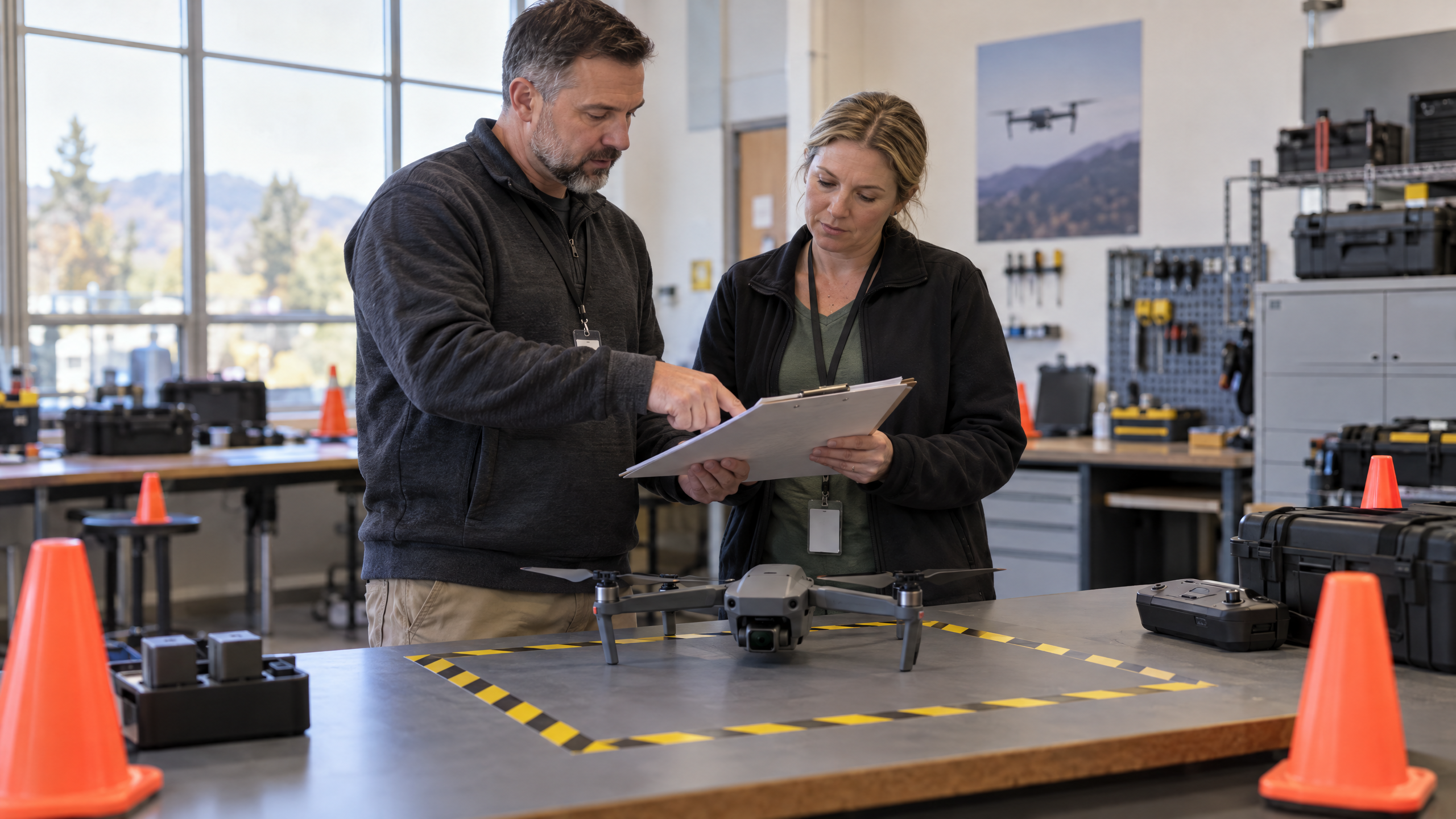
Do not treat an FAA knowledge objective as a promise that every learner will earn a certificate. The FAA states that a first-time Remote Pilot applicant must be at least 16 years old and pass the Unmanned Aircraft General knowledge test, among other requirements. A strong school curriculum can build relevant knowledge and habits while keeping credential planning accurate, age-appropriate, and aligned with district policies.
3. Is Instruction Sequenced From Concepts to Applied Missions?
The strongest curriculum moves from foundational understanding to guided practice and then to an applied mission. It does not open with a drone in the air and hope that engagement becomes learning. Early lessons should establish vocabulary, safety practices, aviation context, and basic systems thinking. Next, learners should rehearse planning and decision-making through low-risk scenarios. Only then should the program ask teams to carry out a mission, collect or interpret evidence, and explain what they would improve.
For CTE leaders, sequence is also an equity and staffing issue. Every learner should have a meaningful role in a mission: safety officer, visual observer, mission planner, payload or data lead, documentarian, or analyst. These roles make teamwork visible and prevent flight time from becoming the only measure of participation. They also mirror the coordinated workflows educators want learners to recognize in professional settings.
“A drone is the tool. Curriculum is the operating system that turns a flight into evidence of learning, safety, and career awareness.”
Ask to see a complete lesson arc, not just a catalog of topics. For each lesson, instructors should receive an objective, materials list, preparation guidance, facilitator steps, checks for understanding, adaptation options, and a clear artifact or rubric. A curriculum that is easy to teach consistently is more valuable than a larger library that relies on a teacher to build the sequence alone.
4. Can Educators Run It Within the Real School Day?
Implementation details determine whether a promising idea becomes a durable program. Evaluate whether a provider has planned for short periods, block schedules, indoor alternatives, weather disruptions, equipment rotation, and the difference between one instructor and a full program team. A lesson that depends on perfect outdoor conditions or a single device per learner may create frustration rather than a reliable learning routine.
Look for station-based lesson designs. One team might complete a flight-planning scenario while another reviews airspace concepts, analyzes a sample image set, rehearses a preflight checklist, or prepares a project brief. This approach keeps learning active when conditions do not permit flight and gives teachers more control over inventory and supervision. It also gives administrators a clearer picture of how the program can scale without reducing safety or instructional quality.
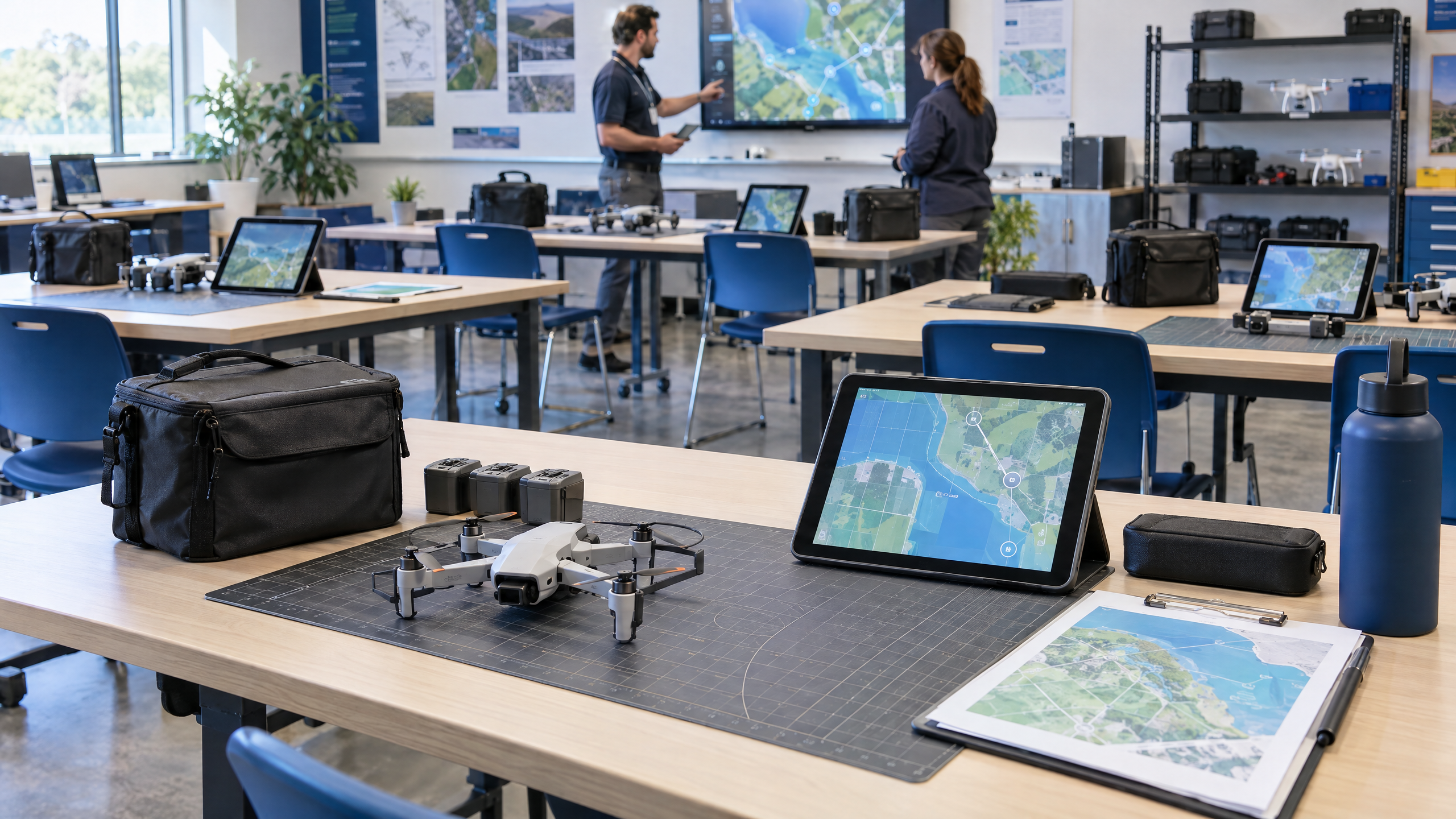
Ask for an implementation map that names the time commitment for launch, lesson pacing, materials management, instructor preparation, and program review. The answer should be specific enough for a CTE director to discuss with campus leadership and specific enough for a teacher to use on Monday morning.
Implementation-ready materials also reduce the risk that a program depends on one enthusiastic champion. When procedures, lesson assets, and assessment expectations are documented, a department can share responsibility across teachers and preserve continuity through staffing changes. That is particularly important for a new CTE offering: operational confidence should be designed into the curriculum rather than rebuilt from scratch each semester.
5. Does It Connect Drone Data to the Pathway You Already Offer?
Drone education becomes more relevant when the aircraft is part of a pathway-specific workflow. In construction, a mission can support site documentation and visual communication. In agriculture, it can frame observation and condition-monitoring questions. In engineering, it can introduce systems, iterative design, and data-informed decisions. In public safety, it can teach mission planning, situational awareness, and responsible coordination. In IT, it can connect sensor-generated information to data stewardship and clear reporting.
The curriculum does not need to claim that one project simulates every professional environment. It should give educators authentic constraints and useful artifacts: a mission plan, a risk assessment, a field checklist, an observation log, a map interpretation, a stakeholder update, or a reflection on data quality. Those artifacts make learning assessable and help learners see that professional drone work is more than flight control.
Bring Career-Connected Drone Learning to Your CTE Program
See how an educator-focused curriculum can support safe, structured implementation.

6. How Will You Measure Readiness and Improve the Program?
Assessment should make readiness visible across knowledge, judgment, teamwork, and communication. A good drone curriculum for high school includes short knowledge checks and performance tasks, but it also gives instructors tools to observe process. Can a team explain a go/no-go decision? Can it follow a preflight routine? Can it document a mission and identify a limitation in its evidence? Can it present a finding to a nontechnical audience? These are practical measures of career-connected learning.
At the program level, leaders need a concise scorecard rather than a stack of isolated worksheets. Useful indicators might include lesson completion, instructor confidence, completed artifacts, observed safety routines, pathway alignment, and educator feedback about schedule fit. Review those signals after the first implementation cycle. They will identify where teacher training, materials, policies, or pacing need attention before the program expands.
Share the review with the people who make the program possible: instructors, administrators, operations staff, and local advisory partners where appropriate. Their perspective can reveal whether the learning tasks feel credible, whether evidence is easy to interpret, and whether the routine is manageable at scale. This is not a compliance exercise. It is the feedback loop that converts a promising pilot into a stable instructional offering.

Build review into the calendar. The FAA’s guidance for educators emphasizes that drone operations are governed by rules, and technology and policy can change. An annual curriculum review, plus a pre-term operational check, helps the program keep lessons, procedures, and resources current. It also signals that your school treats UAS education as a professional learning environment.
7. The Questions to Ask Any Drone Curriculum Provider
When you are ready to compare options, ask direct questions and request the materials that answer them. First, what outcome does the program support? Ask the provider to map its curriculum to your pathway and the time you have available. Second, how are safety and compliance taught and checked? Look for routines, observable evidence, and guidance that respects your school’s operating context.
Third, what does an instructor receive for each lesson? A complete answer includes facilitation materials, pacing, equipment guidance, assessment tools, and adaptations. Fourth, how does the program work with our schedule and sites? Confirm indoor, outdoor, short-period, and weather-contingency options. Fifth, what applied missions and artifacts are included? You want more than activities; you want work products that demonstrate reasoning and communication.
Sixth, how are assessment and reporting handled? Ensure that the program gives your team a usable way to assess knowledge, execution, and reflection. Finally, what implementation support is available? The best curriculum still needs an adoption plan. Ask about onboarding, professional learning, troubleshooting, and how the provider helps your team adapt the program to an existing CTE pathway.
A curriculum decision is strongest when instructional leaders, CTE directors, teachers, and operations stakeholders can all see their responsibilities in the plan. The objective is not to add another technology initiative. It is to establish a safe, teachable, and career-connected learning system that educators can run with confidence.
Key Takeaways
- Define the pathway outcome before selecting equipment or lessons.
- Make safety, risk assessment, and compliance visible in daily routines.
- Choose a sequence that moves from concepts to applied missions and useful artifacts.
- Plan for real schedules, supervision, weather, and equipment rotation.
- Measure instructional quality and educator readiness, then improve before scaling.
Ready to evaluate a drone curriculum that fits your CTE program?
Book a demo to explore an educator-focused, implementation-ready approach for your school or district.
Sources: Federal Aviation Administration—Become a Certificated Remote Pilot; Federal Aviation Administration—Educational Users; National Center for Education Statistics—Career and Technical Education in the United States.