
How to Build a Drone CTE Program of Study: Align Curriculum With Perkins V
Meta description: Learn how to build a drone CTE program of study that aligns curriculum, career pathways, credentials, partnerships, and assessment with Perkins V priorities.
A drone course can be engaging on day one. A drone CTE program of study does more: it connects technical learning, academic application, employability skills, local workforce needs, and a next step after graduation. That distinction matters when a teacher proposes a pathway, a CTE director completes a local needs assessment, or an administrator evaluates a technology investment.
The goal is to build a coherent learning experience in which students explore how uncrewed aircraft systems support real work, practice transferable problem-solving, and see how a sequence of courses can lead to credentials or postsecondary options. The federal Programs of Study guidance from the U.S. Department of Education offers a useful planning lens: programs should combine academic, technical, and employability learning; respond to local industry needs; and progress from broad exploration toward more specific preparation.1
That is a design lens, not a universal approval checklist. Your state CTE framework, local program-approval process, district safety policies, and local Comprehensive Local Needs Assessment remain the sources of truth. But if your team needs a disciplined way to turn a drone elective into a pathway-ready offering, the steps below provide a practical starting point.

Key Takeaways
- A drone course becomes a CTE pathway when it is sequenced, skills-based, and connected to local opportunity.
- Use Perkins V program-of-study criteria as a planning lens, then validate against state and district requirements.
- Map technical, academic, employability, and safety outcomes—not only flight skills.
- Bring employers and postsecondary partners in early to validate the pathway.
- Build assessment evidence from the beginning so improvement is routine.
What Perkins V Alignment Means for a Drone CTE Program
“Perkins V alignment” can sound abstract until a school translates it into planning questions. The law and related federal guidance describe a program of study as more than an individual course. A strong program incorporates challenging state academic standards, addresses academic, technical, and employability skills, aligns with regional or local industry needs, becomes more specific over time, offers multiple entry and exit points that can include credentials, and culminates in a recognized postsecondary credential.1
For a drone pathway, those ideas can become six straightforward questions. What local applications of drone technology are relevant to our learners and partners? Where will students apply science, mathematics, communication, and data skills? Which experiences should come first, and which should be reserved for an advanced course or capstone? What evidence will show that students can plan, operate, analyze, and communicate responsibly? Which credentials, dual-credit opportunities, or postsecondary programs make sense in our region? Finally, who will review the pathway so it remains current?
The answer does not need to be a large launch in the first semester. A school might begin with a carefully designed foundational course and a documented expansion plan. The important point is that the course is intentionally connected to a sequence and to outcomes beyond the aircraft itself. The Department of Education’s framework identifies 10 supporting elements for comprehensive programs of study, including partnerships, professional development, course sequences, credit transfer, instructional strategies, and technical-skill assessment.1 That gives CTE leaders a practical agenda for the conversations that accompany curriculum selection.
Choose the Career Context Before You Choose the Lesson List
Drone technology is best taught in the context of work students can understand. Start by asking which community problems, industries, and career clusters make sense in your area. A rural community may want to explore agriculture, natural resources, or infrastructure inspection. A district with public-sector partners may see applications in emergency management or public service. A region with technology employers may be interested in data collection, geospatial analysis, systems operations, or entrepreneurship. The objective is not to promise a job outcome; it is to make the learning relevant and to identify the standards, partners, and projects that belong in the pathway.
The modernized National Career Clusters Framework is a helpful organizing tool for this discussion. It includes 14 Career Clusters and 72 Sub-Clusters, along with cross-cutting clusters and Career Ready Practices that can be embedded across programs.2 Because drone work can intersect with Digital Technology, Agriculture, Energy & Natural Resources, Public Service & Safety, Supply Chain & Transportation, and Management & Entrepreneurship, it is particularly important to choose a primary context rather than trying to teach every application at once.
Bring your advisory group into this choice early. Ask employers or workforce partners which tasks are appropriate to discuss with students, what entry-level habits they value, how they evaluate technical communication, and where their data, safety, or documentation practices matter. These conversations can also surface local constraints, including privacy expectations, sites that are unsuitable for school flight practice, and skills that need to be taught before hands-on work begins. The framework’s 2024 modernization drew on input from more than 3,500 CTE professionals and validation from more than 200 industry representatives—an example of why external validation matters when pathways evolve.3
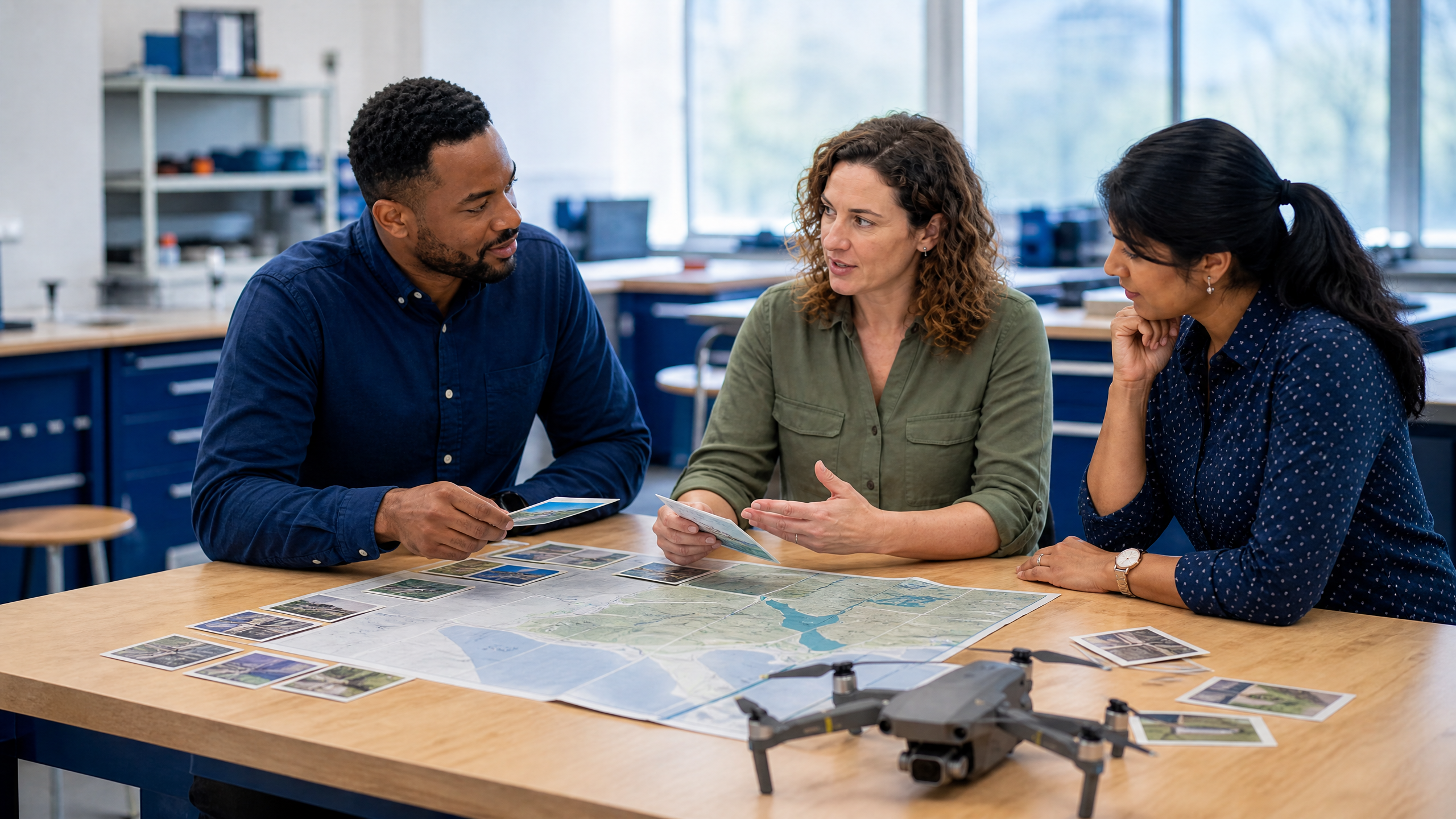
A strong drone pathway is not defined by the aircraft on the shelf. It is defined by the career problem students learn to solve with it.
Build a Course Sequence That Progresses in Specificity
Programs of study are expected to progress from broad industry or career-cluster learning toward more occupation-specific instruction.1 A drone pathway can honor that progression without assuming that every school will offer four dedicated courses immediately. Start with the sequence you can sustain, document the intended next step, and make sure each course has a distinct purpose.
1. Foundations and career exploration
A first course can introduce aviation and drone-system vocabulary, community applications, safe decision-making, mission planning, basic data awareness, and career research. Students should understand why preflight planning, situational awareness, documentation, and clear communication matter before they undertake more complex tasks. Academic connections are natural here: weather and forces of flight support science, coordinate systems and measurement support mathematics, and career research builds technical literacy.
2. Flight systems and operational practice
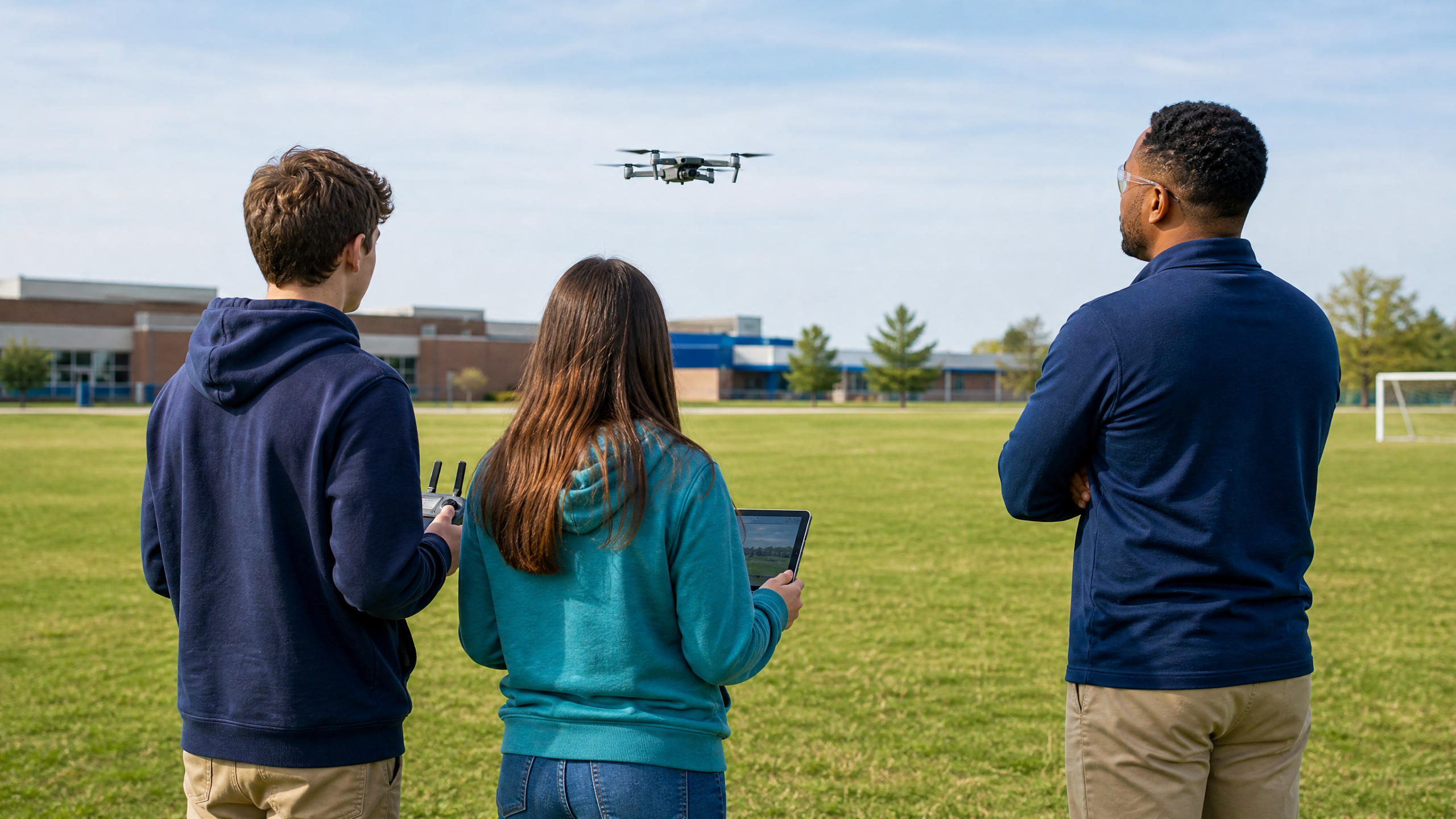
The next stage can deepen systems knowledge and supervised operational practice within school and district policies. Learners can rehearse preflight and postflight routines, identify how payloads and sensors affect a mission, complete checklists, document observations, and evaluate whether a plan should proceed. Educators should use approved spaces, clear supervision, and local requirements; flight time is not a substitute for the planning and reflection that makes the experience instructional.
3. Applied mission and data problem-solving
An intermediate or advanced unit can organize learning around a defined, age-appropriate problem. Depending on your primary career context, students might design a mock site documentation workflow, plan a precision-agriculture observation exercise, compare visual data-collection methods, or create a public-safety communication scenario without conducting a live operational response. The key is to require students to explain their objective, constraints, evidence, and recommendation—not simply capture footage.
4. Capstone, credential, or postsecondary bridge
The final stage can help students synthesize technical performance, career-ready behaviors, and communication. A capstone may involve a portfolio, an employer-reviewed presentation, a simulated client brief, a technical report, or a validated assessment. Where a local college has an aligned opportunity, the school can explore articulation or dual-credit arrangements through its approved processes. This stage should connect students to a credible next step while remaining realistic about the school’s staffing, facilities, and partner capacity.
Map Outcomes Across Technical, Academic, Employability, and Safety Skills
A pathway gains credibility when its learning outcomes are visible. Instead of listing broad themes such as “students learn drones,” use a crosswalk that identifies what students will know, do, produce, and explain. A simple planning table can have four columns: technical outcomes, academic applications, employability behaviors, and safety or operational practices. Each project then becomes evidence for more than one goal.
For example, a mission-planning task can ask students to calculate scale or distance, interpret a weather scenario, create a risk-control plan, select an appropriate collection method, and brief a teammate. The technical outcome may be a completed mission plan. The academic outcome may involve quantitative reasoning or scientific explanation. The employability outcome may involve role clarity, revision after feedback, and concise presentation. The safety outcome may be a documented go/no-go decision based on pre-established criteria.
This type of mapping also keeps the pathway accessible to the wider CTE team. Academic teachers can see where their standards are being applied. Administrators can see how the investment supports measurable instruction. Advisory members can react to concrete student work rather than general descriptions. And students can articulate the transferable skills they are building, even if they later choose a field that is adjacent to, rather than directly within, the drone industry.

Ready to Design a Stronger Drone Pathway?
See how a classroom-ready curriculum can help your educators move from interest to a structured program of study.
Validate the Pathway With Partners and Evidence
Alignment is not a one-time standards exercise. Effective programs of study use partnerships and evaluation to remain responsive. Federal guidance emphasizes ongoing relationships among education, business, and community stakeholders, as well as systems for gathering quantitative and qualitative data about program components and learner outcomes.1 For a drone pathway, that means scheduling recurring advisory conversations and deciding in advance what information the team will review.
Start with a small, purposeful advisory group. A local employer, public agency, community college representative, district CTE leader, teacher, and work-based-learning coordinator can each see a different part of the pathway. Give them specific artifacts to review: a standards crosswalk, course sequence, sample mission-planning rubric, equipment and safety plan, and student portfolio criteria. Their feedback should be recorded, assigned, and revisited rather than treated as an informal conversation.
Partner validation also helps schools separate exciting technology from a sustainable instructional model. A community partner may be able to host a career talk or review student presentations, while a postsecondary partner may clarify prerequisites for a related program. Educators can then decide whether a credential, articulation agreement, or capstone is appropriate for their local pathway. In every case, use your state and district requirements to confirm what may be represented as an approved program, credential pathway, or credit-bearing opportunity.

Use a 90-Day Implementation Checklist
Teams do not need to solve every pathway question in a single meeting. A practical 90-day plan can turn the framework into manageable work. In the first month, review state CTE requirements, local needs-assessment evidence, existing course offerings, and district policies. Identify the primary career context for the program and draft a one-page rationale that explains the learner need, local relevance, and proposed sequence.
In the second month, convene advisory partners and build a standards crosswalk. Define the technical, academic, employability, and safety outcomes for the initial course, then select one or two performance tasks and a clear assessment method. Identify teacher development needs, equipment responsibilities, and the processes governing hands-on activities.
In the third month, test the plan with the people who will operate it. Review pacing, supervision, facilities, partner commitments, and documentation. Decide what first-year data you will collect, such as enrollment, performance-task completion, student reflection, partner feedback, and next-step interest. This creates an improvement cycle that supports evidence-based expansion.
Build an Aligned First Step
A well-designed drone CTE program of study can help a school connect engaging technology to the outcomes that matter most: relevant learning, transferable skills, credible career exploration, and an organized next step. Begin by clarifying your local career context, mapping outcomes, and building a course sequence that can grow responsibly. Then validate the work with the state requirements, community partners, and data that apply to your program.
Whether you are refining an existing technology course or planning an entirely new pathway, starting with a clear structure makes every later decision easier—from lesson design and assessment to advisory conversations and expansion planning.
Build a Drone Pathway Your CTE Program Can Stand Behind
See how Drone Launch Learning can support a structured, classroom-ready drone curriculum for your educators.